

If you are trying to understand how to publish a book, the first thing to know is that publishing is not a single event.
It is a process.
A manuscript becomes a professionally published book through a sequence of editorial, commercial, creative, technical, and distribution decisions. Publishers assess and edit the manuscript, define its readership, and position the book for its market. They also shape the cover and interior, prepare ISBNs and metadata, establish pricing and formats, arrange distribution, proof the finished product, plan the launch, and support long-term marketing.
The process also changes substantially depending on how you choose to publish.
An author pursuing a traditional publishing contract does not follow the same route as an author managing an independent publication. An author working with a professional publishing partner has a different set of responsibilities from someone coordinating every editor, designer, distributor, and marketing supplier alone.
Before deciding where to upload a manuscript or which publishing company to approach, it is therefore worth understanding the publishing process and what professional publication actually involves.
This guide takes you from manuscript to market—and explains the decisions that separate a book that is merely available for sale from one prepared professionally for publication.
In This Guide
- How the Publishing Process Works
- Choosing a Publishing Path
- Steps 1–12: Manuscript to Market
- How Long Publishing Takes
- How Much Publishing Costs
- Common First-Time-Author Mistakes
- Professional Publishing Checklist
- Frequently Asked Questions
How to Publish a Book: The Process at a Glance
Professional book publishing generally moves through four broad stages:
EDITORIAL DEVELOPMENT • PRODUCTION • DISTRIBUTION • MARKET INTRODUCTION
Within those stages sit the decisions that determine the quality and commercial readiness of the final book: manuscript assessment, editing, audience positioning, design, format selection, ISBN and metadata preparation, pricing, proofing, distribution setup, launch planning, and ongoing marketing.
Those functions exist regardless of publishing model.
What changes is who performs them, who finances them, who makes the decisions, who controls the relevant publishing rights, and who carries responsibility for getting the book to market.
This is why uploading a book to Amazon is not synonymous with publishing one.
Uploading is a technical distribution step. Publishing is the professional process that prepares the book for that step—and for everything that comes after it.
First, Decide How You Want to Publish
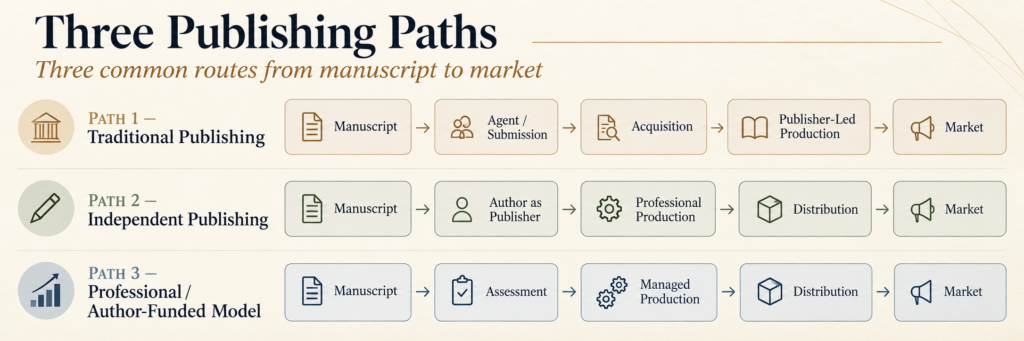
The publishing industry includes more business models than three simple labels can capture.
For a first-time author, however, three broad pathways tend to shape the initial decision: pursuing a traditional publisher, publishing independently, or working within a professionally managed author-funded model.
The differences are substantial.
Understanding the publishing model that best aligns with the book’s goals should happen before production begins.
Traditional Publishing
In traditional trade publishing, a publishing house acquires the right to publish a book under contract and normally assumes the financial responsibility for its core editorial, design, production, distribution, and sales functions.
The publishing agreement determines how the publisher compensates the author, commonly through an advance where applicable and/or royalties on sales.
For many major trade publishers, the route begins with literary representation rather than direct submission. Penguin Random House states that it does not currently accept unsolicited submissions and recommends that writers seeking consideration by a major publisher work with an established literary agent.
An agent may help refine the manuscript or proposal, identify suitable acquiring editors, submit the project, negotiate contractual terms, and represent the author’s interests throughout the publishing relationship.
Traditional publishing is selective by design. Completing a strong manuscript does not guarantee representation, and representation does not guarantee acquisition.
Its advantages can include established editorial infrastructure, publisher-financed production, trade relationships, sales representation, and access to established distribution channels. The trade-off is that the author usually gives the publisher specified publishing rights under contract and will generally have less direct control over decisions such as packaging, pricing, positioning, production, and scheduling.
It is also ordinarily the longest route because acquisition comes before production.
Independent or Self-Publishing
In self-publishing, the author assumes the publisher’s role.
That does not mean the author must personally edit, design, format, distribute, and market the book. Professional independent authors routinely hire editors, designers, illustrators, typesetters, publicists, audiobook producers, and other specialists.
The defining difference is that the author directs the publishing operation and is ultimately responsible for its financial and commercial decisions.
Platforms such as Amazon Kindle Direct Publishing have dramatically lowered the technical barrier to publication. An author can prepare files, configure book information, set pricing, upload print and digital editions, and make a title available to customers without securing a conventional publishing contract.
That accessibility is valuable.
It should not be confused with professional readiness.
A book can be technically available for purchase while still suffering from structural editorial problems, weak copyediting, inappropriate cover design, poor metadata, unsuitable pricing, limited distribution, or no coherent plan for reader acquisition.
Self-publishing gives the author considerable control.
It also transfers the publisher’s responsibilities to the author.
Hybrid Publishing and Publishing Services
Author-funded publishing arrangements require more careful terminology.
Marketing materials often use the terms hybrid publishing, assisted publishing, partnership publishing, and publishing services inter changeably.
They do not necessarily describe the same business model.
The Independent Book Publishers Association has established an 11-point standard for companies representing themselves as hybrid publishers. Its criteria include vetting submissions, transparent and understandable contracts, professional editorial and production standards, publication under the publisher’s own imprint and ISBNs, distribution, sales performance, rights management, and higher-than-standard author royalties in recognition of the author’s financial contribution.
A company that simply charges an author to produce a book does not automatically meet that definition.
Publishing service providers operate differently. They may provide editing, design, production, account setup, distribution assistance, marketing, or project management while the author remains the publisher.
For authors evaluating any paid publishing relationship, the label matters less than the underlying agreement.
Examine who owns the copyright. Examine which publishing rights the agreement licenses or assigns.
Determine whose name appears on the ISBN registration. Understand who controls the retailer and distribution accounts. Establish who receives sales proceeds, how the company calculates royalties, which files the author owns, what marketing the company actually performs, and what happens if the relationship ends.
A clear publishing contract should make the relationship easier to understand, not more confusing.
Step 1: Determine Whether the Manuscript Is Actually Ready
Finishing a manuscript and finishing a book are different milestones.
Authors naturally become close to their own work. After months or years inside a manuscript, it becomes difficult to see structural weaknesses, repeated ideas, continuity problems, underdeveloped arguments, unnecessary chapters, inconsistent character motivations, pacing issues, or assumptions that make perfect sense to the author but not to a new reader.
Its purpose is to determine whether the book works before the author or publisher invests time and money in production.
In fiction, that can mean examining story architecture, character development, point of view, conflict, pacing, continuity, dialogue, genre expectations, and the effectiveness of the opening and ending.
In nonfiction, the questions may concern the central argument, organization, evidentiary support, chapter progression, repetition, audience level, authority, and whether the book actually delivers what its premise promises.
Memoir introduces another set of editorial decisions. A life unfolds chronologically; an effective memoir does not necessarily need to. Narrative emphasis, memory, privacy, legal sensitivity, characterization of living people, and the difference between personal importance and reader relevance may all require consideration.
The purpose of manuscript assessment is not merely to locate errors.
It is to determine whether the book works before money and time are invested in producing it.
Step 2: Give the Manuscript the Right Kind of Editing
“Editing” is not one service.
It describes several distinct levels of professional intervention, and confusing them can polish a manuscript at the sentence level while leaving structural weaknesses unresolved.
Developmental editing considers the book as a whole. It examines organization, structure, narrative progression, argument, pacing, character arcs, chapter function, gaps, repetition, and whether the manuscript delivers effectively on its premise.
Line editing works more closely with the prose. It considers clarity, rhythm, tone, repetition, awkward construction, transitions, emphasis, and the effectiveness of the author’s voice at paragraph and sentence level.
Copyediting focuses on correctness and consistency: grammar, punctuation, spelling, usage, internal consistency, factual or stylistic inconsistencies, and adherence to an appropriate editorial style.
Proofreading belongs near the end of production. A proofreader catches residual textual errors and formatting problems in the book’s final form.
The order matters.
Proofreading a manuscript that still requires substantial developmental revision is the publishing equivalent of inspecting paintwork before confirming that the building is structurally sound.
Not every manuscript requires the same degree of intervention. Professional publishing begins by determining what the manuscript actually needs rather than applying the same editorial package to every book.
Step 3: Define the Reader Before You Design the Book
One of the most important publishing questions is also one of the simplest:
Who is this book for?
“Everyone” is not a market position.
A book enters a marketplace crowded with other books competing for the attention of particular readers. Before designing the cover, finalizing the subtitle, writing the retail description, or selecting categories, the publisher needs to understand where the book belongs.
For fiction, that means understanding genre and subgenre, readership, comparable titles, age category where relevant, tonal expectations, and the visual signals readers associate with that part of the market.
For nonfiction, it means identifying the reader’s problem or interest, the promise made by the book, competing titles, the author’s authority, and the clearest reason a reader should choose this treatment of the subject.
Comparable titles are useful here when understood correctly.
They are not books to copy.
They help a publisher understand the commercial environment surrounding a project: reader expectations, price ranges, cover conventions, trim sizes, positioning language, category behavior, and the standards against which the book will inevitably be judged.
Publishing decisions become considerably stronger when market positioning happens before production rather than being invented afterward.
Step 4: Design a Book That Belongs in Its Market
Professional cover design is not primarily an illustration exercise.
It is communication.
Before a prospective reader knows whether the writing is excellent, the cover has already communicated genre, tone, professionalism, audience, and perceived value.
Typography, hierarchy, imagery, composition, color, subtitle treatment, author-name prominence, genre conventions, and thumbnail legibility all contribute to that communication.
A cover can be visually beautiful and still be commercially wrong.
A literary novel packaged like a thriller creates the wrong expectation. A serious business book that resembles a homemade workbook may struggle to establish authority. A children’s book designed without regard to age category can confuse the very buyer it needs to attract.
Interior design serves a different purpose.
Readers should rarely notice excellent typesetting. They should simply be able to read comfortably.
Trim size, margins, typography, line spacing, paragraph treatment, chapter openings, page numbers, headers, front matter, back matter, image placement, tables, footnotes, and other elements affect the physical reading experience.
Print and ebook editions also require different technical thinking. A conventional ebook is generally reflowable, meaning its text adapts to device size and reader settings. A print edition has a fixed page architecture.
One file should not simply be assumed to serve both purposes.
Step 5: Choose the Formats the Book Actually Needs
The availability of paperback, hardcover, ebook, and audiobook formats does not mean every title must launch in all four.
Format strategy should follow the readership and commercial purpose of the book.
Paperback is often attractive because of accessibility, familiarity, and price. Hardcover may be valuable for premium positioning, gifts, institutional use, collectors, or categories in which readers expect it.
Ebooks provide immediate digital delivery and remove physical inventory concerns. Their pricing and readership patterns, however, can differ significantly by category.
Audiobooks should be regarded as a separate publishing product. Narration, performance, recording, mastering, quality control, rights, distribution, and royalty structures all require their own decisions.
Publishing more formats is not automatically better publishing.
The relevant question is which formats make commercial and reader sense for this particular title.
Step 6: Prepare ISBNs, Copyright Information, and Metadata Correctly
Some of the least visible elements of publishing are among the most consequential.
An ISBN, or International Standard Book Number, is an identifier used by the book trade to identify a particular book product. Different print formats ordinarily require different ISBNs because a paperback and hardcover are separate products.
Amazon KDP currently requires ISBNs for paperback and hardcover books while allowing Kindle ebooks to be published without one. It can provide eligible print books with a free KDP ISBN, although that identifier is restricted to KDP; publishers who obtain their own ISBNs can use those identifiers across compatible publishing and distribution services.
An ISBN is not copyright registration.
Under U.S. law, copyright protection exists once an original work is fixed in a tangible form—for example, when the manuscript is written on paper or saved digitally. Registration with the U.S. Copyright Office is a separate legal step. It creates a public record and provides important additional benefits, including prerequisites and remedies relevant to enforcement of U.S. works.
Then comes metadata.
Book metadata is the structured information retailers, distributors, libraries, search systems, and readers use to identify, classify, display, and discover a title.
It includes elements such as title, subtitle, author, contributors, ISBN, description, categories, keywords, format, language, publication date, pricing, audience information, and edition data.
Metadata is not administrative housekeeping.
It influences where a book appears, how accurately it is categorized, what information retailers display, and whether the people most likely to want it can find it.
A professionally edited and designed book with careless metadata is only partially prepared for the market.
Step 7: Build a Distribution Strategy, Not Merely an Amazon Listing
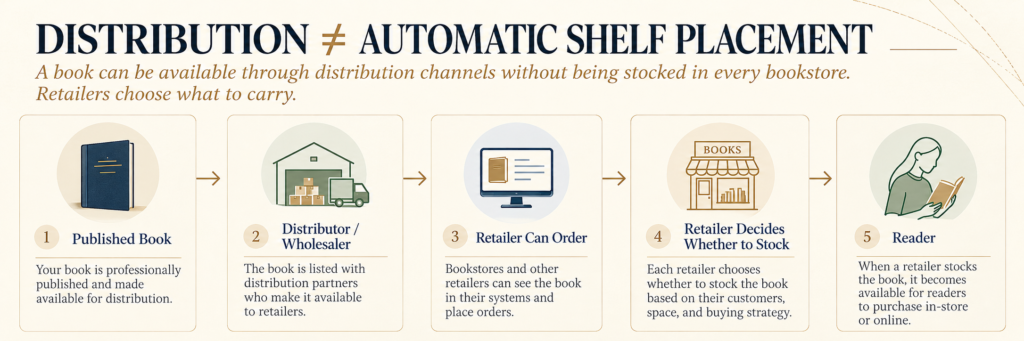
Publishing and distribution are connected, but they are not interchangeable.
Publishing prepares the book as a commercial product. Distribution creates the channels through which retailers, libraries, wholesalers, institutions, and readers can obtain it.
Amazon KDP is an important route to Amazon’s marketplace.
It is not the whole book trade.
IngramSpark provides access through Ingram’s distribution network to tens of thousands of bookstores, online retailers, libraries, schools, and other outlets worldwide.
The word access is critical.
Distribution does not mean shelf placement.
A book may be available for a bookstore to order without that bookstore choosing to stock copies. Individual retailers still make purchasing decisions based on demand, category, pricing, wholesale terms, returnability, sales history, local relevance, and available shelf space.
This distinction is frequently misunderstood by first-time authors and sometimes blurred in publishing marketing.
“Available to bookstores” and “stocked in bookstores” are not the same claim.
A professional distribution plan should state which one it actually means.
Step 8: Set Pricing and Trade Terms Deliberately
A book’s list price should not be chosen according to what the author feels the work is worth.
Book pricing is a market and unit-economics decision.
Publishers consider comparable titles, format, page count, printing cost, retail expectations, wholesale discount, distribution terms, author or publisher compensation, and the strategic role of the edition.
A price that is too low can damage margins and positioning. A price that is too high introduces unnecessary purchasing resistance.
For print books entering wholesale channels, the retail price is only one component of the economics.
Retailers ordinarily acquire books below list price. Manufacturing cost must also be recovered. Depending on the distribution strategy, wholesale discount and returnability can materially affect both retailer attractiveness and publisher risk.
Those decisions should be understood before publication.
The first royalty statement is a poor place to discover how the economics of the book work.
Step 9: Proof the Finished Product
Editing does not eliminate the need for proofing.
Production itself can introduce errors.
A heading can fall in the wrong place. A paragraph can be separated incorrectly. A running head may appear where it should not. A page reference can change. An image can reproduce poorly. A spine can be misaligned. A cover element that looked acceptable on screen may feel wrong when wrapped around a physical book.
The final files should therefore be examined as finished publishing products rather than as manuscripts.
For print editions, a physical proof is especially valuable.
A PDF cannot fully reproduce paper stock, trim, ink density, cover finish, binding behavior, margins, spine width, or the physical relationship between the design and the object the reader will actually hold.
Quality control is not the glamorous part of publishing.
It is one of the parts readers notice immediately when it has been neglected.
Step 10: Begin the Launch Before Publication Day
A launch should not begin when the purchase button becomes active.
By then, a significant amount of launch work should already have happened.
Positioning, retail copy, author information, metadata, visual assets, website presence, advance-reader strategy, review outreach, publicity opportunities, email communication, social content, advertising preparation, and other campaign elements may all need to be developed before release.
The appropriate mix depends on the book.
A business author may need podcast appearances, professional networks, bulk sales, speaking opportunities, and thought-leadership content.
A novelist may rely more heavily on genre readership, advance readers, reviews, retailer advertising, social discovery, series strategy, and reader communities.
A memoir may have strong opportunities through organizations, causes, communities, regional media, or groups closely connected to its subject.
A children’s book may require a different ecosystem again: educators, parents, libraries, schools, events, and specialist booksellers.
Marketing becomes inefficient when tactics are selected before the audience is understood.
Professional book marketing starts with reader behavior, not with a list of promotional services.
Step 11: Publish and Allow for Distribution Lead Time
Once editorial work is complete, files have passed quality control, metadata is correct, pricing is established, and distribution settings are ready, the book can move toward release.
Even then, publication is not always instantaneous across the market.
Retailers and wholesalers receive, process, and display metadata on their own schedules. A title can therefore appear in one channel before it becomes visible in another.
This is one reason publishers work backward from publication dates.
A credible schedule should leave room for final files, proofs, corrections, metadata feeds, advance copies, review outreach, publicity, retailer setup, and prepublication marketing.
A publication date should not be selected solely because it is emotionally meaningful.
It is an operational date around which a publishing program is built.
Step 12: Continue Marketing After Launch
Publication day is not the end of a book’s commercial life.
For many books, it is merely the point at which long-term discovery begins.
Search visibility, reviews, reader recommendations, publicity, email marketing, author appearances, paid advertising, seasonal opportunities, price promotions, institutional sales, rights opportunities, partnerships, and subsequent books can continue generating attention long after launch week.
Different books also create value in different ways.
A business book may generate consulting clients, speaking engagements, corporate orders, or professional authority that exceeds its direct retail revenue.
A novel may become more commercially valuable as part of a series or a larger author catalogue.
A memoir may develop a long life through communities, organizations, educational programs, advocacy groups, or events connected to its subject.
A useful publishing strategy therefore asks not only how the book will sell, but what the book is intended to accomplish.
How Long Does It Take to Publish a Book?
There is no responsible universal timeline.
Traditional publishing can take considerably longer because representation and acquisition may occur before the publishing process itself begins. A manuscript may spend months seeking representation or acquisition, and an acquired title then enters the publisher’s editorial, production, sales, and seasonal scheduling process.
Independent publishing removes the acquisitions stage but does not eliminate professional production time.
A manuscript requiring substantial developmental work should take longer than a clean manuscript entering copyediting. An illustrated children’s book has different production demands from a straightforward text-only paperback. Audiobooks, complex nonfiction, indexing, illustrations, permissions, and multiple formats all add their own dependencies.
Professionally managed publishing projects can often move more quickly than traditional acquisition-driven publishing because many stages are coordinated directly.
The correct timeline is not the shortest one available.
It is the shortest timeline that allows the required work to be done properly.
How Much Does It Cost to Publish a Book?
For a detailed breakdown of editing, design, ISBNs, printing, distribution, marketing, and other expenses, see How Much Does It Cost to Publish a Book in 2026?
There is no meaningful single answer because the financial structure changes with the publishing model.
In traditional publishing, the acquiring publisher normally finances the standard editorial and production work covered by the publishing agreement.
In self-publishing, the author functions financially as the publisher and decides which professional services to purchase. Those costs can include developmental editing, copyediting, proofreading, cover design, interior formatting, illustration, indexing, ISBNs, printing, audiobook production, distribution setup, website development, publicity, and marketing.
Authors working with publishing partners or service providers may purchase some or all of those functions within a managed project.
Price alone is therefore a poor way to evaluate publishing options.
A low-cost package that produces a cover and files without adequate editing, meaningful distribution, proper metadata, transparent rights, or competent quality control may offer little value.
An expensive package filled with services the book does not need can be equally poor publishing.
The better question is:
What work does this book genuinely require, who will perform it, what will I own when the project is complete, and what commercial infrastructure will exist around the finished book?
The brief specifically identifies the publishing-cost article as the future cluster link for this section.
Common Publishing Mistakes First-Time Authors Should Avoid
Many first-time publishing mistakes are not caused by poor judgment so much as by doing the right things in the wrong order.
A cover may be commissioned before positioning is established. Proofreading may be purchased while structural revisions are still underway. Marketing may begin before the product page, metadata, or distribution is ready. An author may confuse ISBN registration with copyright, distribution with bookstore stocking, or publication with discoverability.
Another frequent mistake is evaluating publishing companies primarily by the size of their promises.
Terms such as “global distribution,” “bookstore availability,” “complete marketing,” “bestseller campaign,” or “Hollywood exposure” have little value unless they are attached to precise, contractually understandable activities.
Clarify what “distribution” means and which accounts hold the book. Confirm who owns the ISBN and whether the agreement assigns or licenses rights. Trace how sales revenue flows, identify the marketing work the company will actually perform, and establish what happens to the files and accounts if the relationship ends.
Publishing rewards specificity.
A Professional Book-Publishing Checklist
Before publication, an author or publisher should be able to answer the following questions with confidence:
- Is the manuscript structurally and editorially ready?
- Which publishing model is being used, and why?
- Who is the intended reader?
- How is the book positioned within its category?
- Has the manuscript received the appropriate level of editing?
- Do the cover and interior meet professional and market expectations?
- Which formats are commercially appropriate?
- Are the ISBN, copyright, imprint, and metadata decisions understood?
- Which distribution channels will carry the book?
- Are pricing, discounts, and other relevant trade terms viable?
- Have the finished digital files and physical proofs been checked?
- Is there a launch strategy and a post-launch plan for reader discovery?
If several of those questions cannot yet be answered, the book is probably not ready for release.
That does not mean the book has failed.
It means the publishing work is not finished.
What Should a First-Time Author Do Next?
If your manuscript is complete or nearly complete, resist the temptation to begin by choosing an upload platform.
Begin by assessing the book.
Determine what editorial stage it has reached. Define the readership. Understand its market position. Decide which publishing model aligns with your goals. Then allow those decisions to determine the editing, design, production, distribution, and marketing work that follows.
The quality of a publishing project is usually determined long before a retailer displays a Buy button.
A professionally published book is not simply one that can be ordered.
It is one in which the manuscript, market position, design, production, metadata, distribution, and reader strategy have been made to work together.
That is the difference between making a book available and publishing it deliberately.
Frequently Asked Questions About Publishing a Book
Can anyone publish a book?
Modern self-publishing platforms have made it technically possible for almost anyone to release a book. That does not eliminate the professional standards readers and retailers apply once the book enters the market. Editing, positioning, design, production, metadata, and discoverability still matter.
Do I need a publisher to publish a book?
No. An author can act as the publisher and coordinate the entire process independently. The more useful question is whether you want to manage the publisher’s responsibilities yourself, seek acquisition from a traditional publisher, or work with professionals who manage some or all of the process.
Do I need a literary agent?
Not for self-publishing, and not for every independent press or professional publishing arrangement. For many major traditional trade publishers, however, literary representation remains the standard route. Submission policies vary by publisher and imprint and should always be checked directly.
Do I need an ISBN?
Print books entering normal commercial channels generally require ISBNs. Amazon KDP currently requires them for paperback and hardcover editions but not for Kindle ebooks. Different book formats that use ISBNs generally require their own identifiers.
Is an ISBN the same thing as copyright?
No. An ISBN identifies a book product within the publishing and bookselling ecosystem. Copyright concerns legal rights in the creative work. They serve completely different purposes.
Do I need to register my copyright before publishing?
In the United States, copyright protection arises when an original work is fixed in a tangible form; registration is not what initially creates copyright. Registration with the U.S. Copyright Office nevertheless provides important additional legal benefits and is relevant to enforcing rights in U.S. works.
Does distribution mean bookstores will stock my book?
No. Distribution can make a title available for a bookstore to order. The retailer still decides whether to purchase and physically stock the book. Availability through a wholesaler should not be represented as guaranteed shelf placement.
Can I publish a book on Amazon myself?
Yes. Amazon KDP allows authors to publish eligible ebook, paperback, and hardcover editions directly. That solves the technical problem of making the book available through Amazon. It does not replace editorial preparation, market positioning, broader distribution strategy, or book marketing.
How do I know when my manuscript is ready?
A manuscript is generally ready to enter production when substantial structural and editorial questions have been resolved. If chapter order, major character arcs, argument structure, missing material, extensive rewriting, or the fundamental positioning of the book are still changing, production is usually premature.
Publishing Begins Before Publication
At Publishers of New York, we believe the publishing conversation should begin with the manuscript—not with a predetermined package.
Our process starts by considering the work itself: its editorial condition, intended readership, market position, publishing objectives, and what it will require to compete professionally.
From there, editing, design, production, distribution, and launch decisions can be built around the book rather than forcing the book into a standardized process.
If you have completed—or nearly completed—a manuscript and want to understand what should happen before publication, the next step is editorial consideration.