

Traditional publishing vs self-publishing affects far more than who puts a logo on the spine. The publishing model determines who pays, who decides, which rights are licensed, how the book reaches the market, how revenue is calculated, and who carries the commercial risk.
Authors are often told that choosing how to publish a book comes down to a simple question: traditional publishing or self-publishing. That framing is no longer sufficient.
For authors comparing traditional publishing vs self-publishing, hybrid publishing adds a third model that changes who pays, who controls rights, and who manages the process.
The modern publishing landscape includes conventional trade publishing, independent author-publishing, legitimate hybrid publishing, and a wide range of publishing-service arrangements that may resemble one another on the surface while operating very differently underneath.
The important question is therefore not Which publishing model is best? There is no universally superior model. The useful question is Which set of responsibilities, economics, rights, timelines, and trade-offs is appropriate for this book and this author?
A publishing model determines who assumes the financial risk, who controls editorial and design decisions, who owns or licenses particular rights, who manages distribution and sales, how royalties or sales proceeds are calculated, how quickly the book can reach the market, and how much operational responsibility remains with the author.
Those distinctions matter much more than the labels themselves. A professional publishing decision begins by understanding them clearly.
The Short Answer
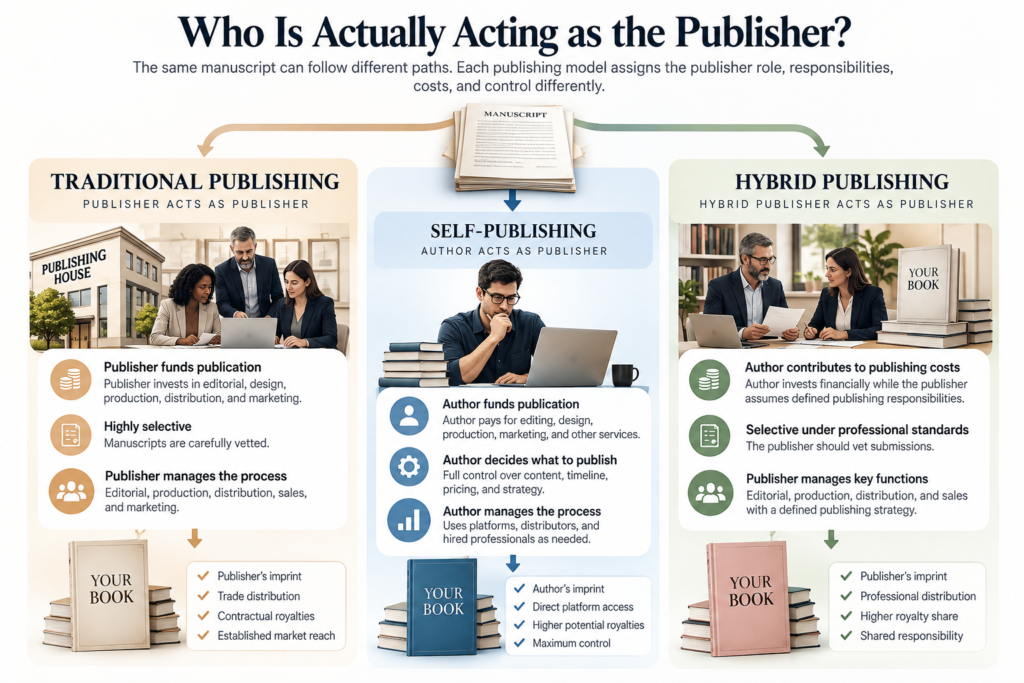
Traditional publishing generally places the financial and operational responsibility for publication on an acquiring publisher in exchange for licensed publishing rights and a contractual royalty structure.
Self-publishing places the publisher role—and its costs, control, risks, and potential upside—on the author.
Legitimate hybrid publishing uses an author-subsidized model while the hybrid publisher remains responsible for professional publishing functions and must meet meaningful standards beyond simply selling services.
In This Guide
- Publishing Models at a Glance
- Traditional Publishing
- Self-Publishing
- Hybrid Publishing
- Costs, Financial Risk & Royalties
- Rights & Creative Control
- Speed, Distribution & Marketing
- Which Path Fits Your Goals?
- Questions to Ask Before Choosing a Publisher
- Common Misconceptions
- Frequently Asked Questions
Traditional Publishing vs Self-Publishing: At a Glance, Including Hybrid Publishing
The table below is deliberately broad. Contracts, imprints, genres, publishers, platforms, and individual projects vary. It is a framework for understanding where responsibility usually sits—not a substitute for reading the agreement attached to a specific publishing offer.
Who Pays, Controls, and Manages the Book?
| Factor | Traditional Publishing | Self-Publishing | Hybrid Publishing* |
|---|---|---|---|
| Who acts as publisher? | Acquiring publishing house | Author / author-owned imprint | Hybrid publisher |
| Who funds core publication? | Publisher | Author | Author subsidizes; publisher assumes defined publishing responsibilities |
| Selection / vetting | Highly selective | Author decides what to publish | Should be selective under professional hybrid standards |
| Editorial / design control | Publisher has substantial contractual control | Author has final control | Shared or publisher-led; contract dependent |
| Copyright | Usually remains with author; specified publishing rights are licensed | Author retains copyright and controls publishing rights | Should be clearly defined by contract; copyright need not be transferred |
| Upfront author cost | Normally no charge for core trade publication | Author funds chosen services and production | Author contributes materially to publishing costs |
| Royalty / proceeds | Contractual royalties; advance may apply | Author receives platform/distributor proceeds after costs | Typically higher royalty share than traditional because author invests upfront |
| Speed to market | Usually slowest because acquisition and list scheduling precede release | Potentially fastest if manuscript and production are ready | Often managed on a defined production schedule |
| Distribution | Publisher-managed trade distribution and sales channels | Author builds distribution through platforms, wholesalers, direct sales, etc. | Should include genuine distribution, not merely file upload |
| Marketing responsibility | Publisher leads its program; author participation still matters | Author is responsible for strategy and execution unless outsourced | Publisher should have a sales/marketing strategy; author involvement still varies |
| Financial risk | Primarily publisher | Primarily author | Shared in structure, with significant author investment |
| Operational workload for author | Lower on production; still high on writing/platform/publicity | Highest unless author hires and manages professionals | Lower than DIY self-publishing if publisher genuinely manages the process |
In this article, “hybrid publishing” refers to the professional model described by the Independent Book Publishers Association (IBPA), not to every company that charges authors for publishing-related services.
What Traditional Publishing Actually Means
Traditional publishing is an acquisition model. A publisher decides that a manuscript fits its list and commercial strategy, acquires specified publishing rights under contract, and invests its own capital in bringing the book to market.
That investment normally includes the core editorial and production work required by the publisher: editing, design, typesetting, manufacturing or print setup, metadata, distribution, sales, and some level of marketing and publicity. The author is not buying those services from the publisher as a condition of being published.
For many large trade houses, the route begins with a literary agent. Penguin Random House, for example, states that it does not currently accept unsolicited submissions and recommends that writers seeking consideration by a major publisher work with an established literary agent. Smaller presses, independent publishers, academic presses, specialist houses, and individual imprints may have different submission policies.
If the book is acquired, the publisher and author enter a contract defining the rights being licensed, the term, territory, formats, royalty structure, delivery obligations, publication commitments, accounting, reversion conditions, and other material terms.
The author may receive an advance against future royalties, although advances vary widely and are not universal across every part of the industry.
The essential point is that the publisher is making an investment decision.
Selection is therefore inseparable from traditional publishing. A manuscript can be publishable and still not be acquired because acquisition decisions also involve list strategy, timing, sales expectations, comparable titles, budget, editorial enthusiasm, and the publisher’s appetite for a particular category.
What Traditional Publishing Gives the Author and What It Does Not
A traditional deal can provide an established publishing infrastructure that is difficult for an individual author to replicate: experienced editorial teams, professional design and production, established metadata systems, trade distribution, sales representation, retailer relationships, publicity infrastructure, rights departments, and an imprint with existing market recognition.
It does not mean the author stops participating in the commercial life of the book.
Authors are commonly expected to contribute to publicity, interviews, events, social media, newsletters, professional networks, or other audience-building activity. The scale of publisher marketing also varies enormously by title. A lead title with substantial internal support and a modestly acquired midlist book do not necessarily receive the same resources.
Traditional publishing also does not mean the author retains unilateral control over every production decision.
A publishing contract gives the publisher meaningful commercial authority. Cover design, title changes, pricing, release date, format strategy, metadata, and marketing decisions may involve author consultation, but the contract and publisher determine where final authority lies.
What Self-Publishing Actually Means
Self-publishing means the author becomes the publisher.
That statement is more useful than saying self-publishing means “uploading your own book,” because it identifies what actually changes. The author assumes responsibility for the functions a publishing house would otherwise perform.
The author decides whether the manuscript is ready, hires or performs editorial work, commissions the cover, prepares the interior, obtains or assigns identifiers, establishes metadata, chooses formats, controls pricing, selects distribution channels, manages proofs, plans the launch, finances marketing, receives sales proceeds through publishing accounts, and makes decisions about the book’s long-term commercial life.
Many successful independent authors do very little of that work personally.
They build teams.
An author may hire a developmental editor, copyeditor, cover designer, formatter, illustrator, publicist, audiobook producer, advertising specialist, or publishing consultant. The model is still self-publishing because the author remains the publisher and directs the operation.
Amazon KDP is one important tool within that operation, but it is not the definition of self-publishing. KDP provides a route for authors and publishers to make eligible ebook and print editions available through Amazon.
Other channels can include IngramSpark, Kobo, Apple Books, direct-to-reader ecommerce, audiobook distributors, libraries, wholesalers, specialty retailers, and regional or international partners.
The Advantage of Self-Publishing Is Control—and So Is the Burden
The independent author can control the publication schedule, cover direction, pricing, metadata, advertising, formats, series strategy, promotional timing, and whether the book remains continuously available.
Changes can often be made much faster than inside a large publishing organization.
The same independence means there is no acquiring publisher absorbing the financial risk or imposing professional standards on the project.
When a book needs another developmental edit, the author must recognize and fund the work. A cover that misses the category may go unchallenged without a sales team to catch the problem. Distribution terms that make the book unattractive to bookstores also fall to the author to identify and correct.
This is why good self-publishing can be highly professional while poor self-publishing can be visibly amateur.
The model itself does not determine quality. The standards applied to the work do.
What Hybrid Publishing Actually Means
Hybrid publishing is the most frequently misunderstood of the three models.
The term should not be used as a synonym for “a company that charges an author.”
Under the Independent Book Publishers Association’s hybrid publisher criteria, a hybrid publisher operates like a professional publisher while using an author-subsidized business model. The author contributes financially, but the publisher still assumes genuine publishing responsibilities.
IBPA’s 11-point criteria require, among other things, that a hybrid publisher define a publishing mission, vet submissions, operate transparently, use understandable and negotiable contracts, publish under its own imprint and ISBNs, meet professional editorial and production standards, pursue and manage publishing rights, provide distribution, demonstrate respectable sales, and pay authors a higher-than-standard royalty in recognition of the author’s investment.
That distinction matters because the author-funded marketplace also contains publishing-service companies.
A service provider can be perfectly legitimate and valuable without being a hybrid publisher. In a service-provider relationship, however, the author is generally still functioning as the publisher while the provider supplies contracted services.
Confusing the two models can leave an author uncertain about who is responsible for sales, whose imprint is publishing the book, who controls the ISBN and retail accounts, what rights are being licensed, and why the author is paying the company in the first place.
A Useful Test
If a company calls itself a hybrid publisher, ask what makes it a publisher beyond collecting a fee.
Who selects the books? Whose imprint and ISBN are used? Who is responsible for editorial quality? What trade distribution exists? What sales record can it demonstrate? Which rights does it manage? How are royalties calculated?
The answers should describe a publishing operation, not merely a menu of services.
Hybrid Publishing Is Not “Self-Publishing With a Higher Price Tag”
The defining issue is not price.
It is role and responsibility.
An author can spend heavily on self-publishing and still be the publisher. Conversely, an author can contribute financially to a legitimate hybrid publishing arrangement in which the hybrid publisher selects the project, publishes under its imprint, takes responsibility for professional quality, distributes the book, manages defined rights, and participates economically in sales.
The Authors Guild has also cautioned authors to conduct serious due diligence before signing hybrid contracts, noting that the author’s upfront investment can be substantial and that rights can be difficult to recover if a publisher fails.
A credible hybrid arrangement therefore needs to be evaluated not only on its promised services but on its financial stability, contract, sales record, rights provisions, accounting, and exit terms.
The word “hybrid” should increase the amount of due diligence an author performs, not reduce it.
The Most Important Difference: Who Carries the Financial Risk?
Publishing is a capital allocation decision as well as a creative one.
In a conventional traditional deal, the publisher finances the core publication and accepts the risk that the book may not earn back what was spent acquiring, editing, manufacturing, distributing, and marketing it.
The author contributes the intellectual property and work required under the contract but does not normally purchase the publisher’s core production services.
In self-publishing, the author carries the financial risk.
Editing, design, production, advertising, printing, software, websites, publicists, and other costs are investments made by the author-publisher. The author also keeps the residual upside after retailer, distributor, printing, vendor, tax, and marketing costs.
For a detailed breakdown of those expenses, see How Much Does It Cost to Publish a Book in 2026?.
In hybrid publishing, the author contributes financially by definition. The business logic is that the author’s investment reduces the publisher’s capital exposure and should therefore be reflected in a materially stronger share of sales proceeds and a correspondingly transparent contract.
This is why comparing models only by asking “How much do I pay?” is incomplete.
The more revealing questions are:
Who risks capital? What does that capital buy? Who owns the resulting assets? Who controls the publishing accounts? And how is revenue divided after publication?
Royalties: Why the Headline Percentage Can Mislead You
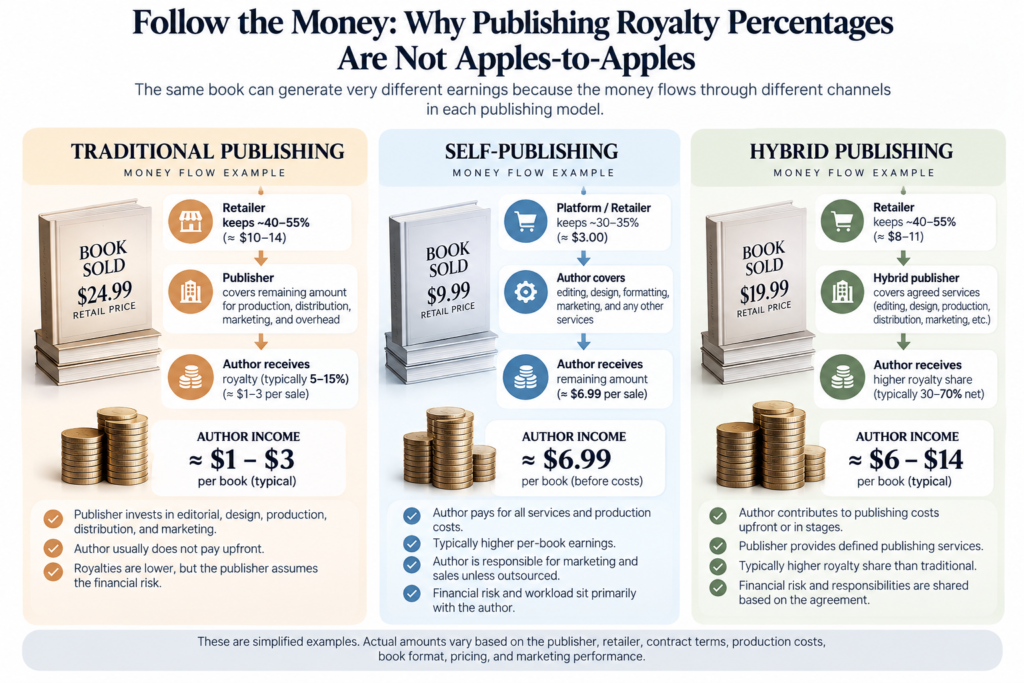
Royalty comparisons are among the most misleading parts of publishing advice because percentages are often quoted without explaining the base on which they are calculated.
The Authors Guild’s Model Trade Book Contract, for example, uses 7.5% of retail price as a model trade-paperback royalty for certain large-trade arrangements and 25% of the publisher’s net receipts for ebooks.
Its hardcover model provisions can escalate from 10% to 15% of retail price. Smaller and medium-sized publishers may calculate royalties on net receipts rather than list price.
By contrast, Amazon KDP currently offers eligible ebooks a 35% or 70% royalty option depending on pricing, territory, delivery costs, and other conditions.
For paperbacks sold through Amazon’s standard channels, KDP currently uses 50% or 60% royalty rates depending on list price and marketplace, then subtracts printing costs. Expanded Distribution uses a different calculation.
Those numbers are not directly comparable.
A KDP “70% royalty” is not economically equivalent to receiving 70% of the profit from a traditionally published book. The independent author has already assumed the publishing costs and may still be paying for editing, design, advertising, printing, software, contractors, returns, and other expenses.
The same caution applies to hybrid royalties.
The Authors Guild notes that hybrid contracts commonly offer royalty percentages substantially higher than traditional contracts—often upwards of 50% of net receipts—precisely because the author has made an upfront investment.
But a high percentage of a poorly defined “net” figure can still be unfavorable.
Always identify three things:
- the percentage,
- the calculation base, and
- the costs deducted before or after that calculation.
Without all three, the royalty number is incomplete.
Rights: Copyright Ownership Is Only the Beginning
Authors frequently ask whether they will “keep the rights.”
That question is important but too broad.
Copyright ownership and publishing rights are related but distinct.
An author can retain copyright while granting a publisher exclusive rights to publish particular formats in particular territories for a defined term.
A publishing agreement might address print rights, ebook rights, audiobook rights, translation rights, territorial rights, dramatic rights, merchandising, serialization, large print, book-club rights, and other forms of exploitation.
In traditional publishing, the publisher normally requires a license or grant of the rights it needs to commercially exploit the work.
The scope of that grant should be read carefully, especially where rights could be reserved by the author or separately sold through an agent.
In self-publishing, the author generally retains control of publishing rights while granting limited licenses to platforms and suppliers as necessary to distribute or sell the book.
The author must nevertheless understand platform terms, exclusivity programs, distributor agreements, and any rights granted to contractors.
In a hybrid arrangement, rights should be no less clear simply because the author is paying.
The contract should specify what is being licensed, for how long, in which territories and formats, how rights revert, and what happens when the agreement ends.
A useful contract question is not simply:
Do I own my book?
It is:
Which rights am I granting, to whom, for what purpose, for how long, and how do I get them back?
Creative Control: Who Has the Final Say?
The answer varies considerably by model and contract.
In self-publishing, the author normally has final authority because the author is the publisher.
That can be liberating, particularly for experienced authors who understand their audience and can assemble a strong team.
It can also become a weakness if “control” is used to avoid professional editorial challenge.
Traditional publishing is collaborative but not author-controlled in the same sense.
A publisher is investing money and lending its imprint, sales infrastructure, and reputation to the project. It therefore needs commercial authority over the product it is taking to market.
Good contracts and healthy publisher-author relationships define consultation and approval rights carefully, but authors should not assume they will have a veto over every cover, price, subtitle, or marketing decision.
Hybrid publishing sits between those structures.
Some hybrid publishers maintain meaningful editorial and design authority because they are responsible for the quality of books carrying their imprint. Others give authors broader approval rights because the author is contributing financially.
The contract should make the balance explicit.
The most productive goal is not maximum control at all costs.
It is appropriate control supported by competent publishing judgment.
Speed to Market: Faster Is Not Automatically Better
Traditional publishing is ordinarily the slowest route because publication follows several stages that do not exist in the same form elsewhere: querying or submission, agent representation where applicable, acquisition, contracting, list scheduling, editorial development, production, sales preparation, advance marketing, and retailer lead times.
Self-publishing can move much faster because the author controls the schedule.
A professionally prepared manuscript can move from final edit to design, proofing, distribution setup, and publication without waiting for acquisition or a seasonal publishing list.
Hybrid and managed publishing models can also operate on defined production schedules because the acquisition and capital-allocation process is usually different from a major trade house.
But speed should be treated as an operational advantage, not a quality standard.
A rushed developmental edit, weak cover, unproofed interior, poor metadata, or launch with no advance preparation simply moves mistakes to market faster.
Distribution: Access to the Market Is Not the Same as Sales
Distribution is one of the areas in which publishing models can differ most materially.
Traditional publishers generally work through established sales and distribution systems.
Sales representatives present lists to accounts, metadata is fed into trade systems, warehouses and wholesalers support fulfillment, and books may receive consideration from bookstores, libraries, specialty retailers, and institutional buyers because the publisher already participates in those channels.
Independent authors can also make books broadly orderable.
IngramSpark, for example, makes enabled titles available through Ingram’s network of bookstores, libraries, online retailers, and other buyers.
But Ingram itself distinguishes availability from actual store stocking.
Retailers still decide what to order, how many copies to carry, and whether the wholesale discount and return terms make the title commercially attractive.
This is an important point when evaluating hybrid or publishing-service offers.
A promise of “global distribution” may mean only that metadata will be sent to major retail databases and the title will be orderable.
That is useful, but it is not the same as having a sales force actively presenting the book to buyers or securing physical placement.
Ask exactly what distribution means in operational terms:
Ask which distributor or wholesaler will handle the book, which territories and formats are covered, and whether the title will be returnable. Then confirm the wholesale terms, whether the agreement includes active sales representation, and whether comparable titles from the publisher actually reach the intended accounts.
For more context on how production and distribution fit into the complete workflow, see the publishing process.
Marketing: No Publishing Model Removes the Need to Find Readers
Authors sometimes imagine the decision as a trade: traditional publishing means the publisher markets the book; self-publishing means the author does.
The reality is more nuanced.
Traditional publishers have sales, marketing, and publicity functions, but resources are allocated according to list priorities, expected opportunity, timing, budget, and performance.
Authors are still commonly expected to participate in media, events, social channels, newsletters, professional communities, or other activities appropriate to the book.
Self-published authors own the marketing problem completely.
They can execute it themselves or hire specialists, but no outside organization is automatically responsible for generating demand.
A professional hybrid publisher should have a defined sales and marketing strategy for each title under IBPA’s criteria.
That does not mean every marketing tactic is included without limit or that sales can be guaranteed.
It means the publisher should be able to explain how the book is expected to reach its market and what the publisher itself will do.
Any company that promises guaranteed sales, guaranteed bestseller status, guaranteed major-media coverage, or guaranteed bookstore stocking deserves heightened scrutiny.
Publishing can create opportunity and improve execution; it cannot make reader demand contractually certain.
Which Publishing Path Fits Different Author Goals?
There is no responsible way to choose a publishing route solely from genre or personality.
The following scenarios are better treated as signals about which model deserves closer investigation.
Traditional Publishing May Deserve Priority When…
- You want to pursue acquisition by an established trade house and are prepared for a selective, potentially lengthy process.
- Upfront publisher-funded production is important to you.
- Your category depends heavily on conventional trade channels, institutional review, bookstore relationships, or a publisher’s established sales infrastructure.
- You are comfortable licensing meaningful publishing rights and collaborating within the publisher’s commercial decision-making structure.
- You are willing to pursue literary representation where your target publishers require it.
Self-Publishing May Deserve Priority When…
- You want to control publication timing, pricing, packaging, metadata, formats, and long-term availability.
- You are prepared to finance professional production and treat the book as a publishing venture rather than an upload project.
- You already understand your readership or have direct access to an audience.
- You are comfortable building and managing a team of editors, designers, distributors, marketers, and other specialists—or learning to perform some of those functions yourself.
- You value direct access to sales data and publishing accounts and accept the financial risk that accompanies that control.
A Legitimate Hybrid or Managed Publishing Relationship May Deserve Investigation When…
- You want a professional publishing team to manage substantial parts of the process but understand that you will contribute financially.
- You do not want to coordinate every specialist and platform independently.
- You value a defined production process, professional quality control, distribution support, and an ongoing publishing relationship.
- You have carefully reviewed the contract, rights, imprint, ISBN structure, distribution, sales record, royalty calculation, and financial obligations.
- The company can demonstrate that it performs genuine publishing functions rather than merely packaging services under the word “hybrid.”
Ten Questions to Ask Before Choosing Any Publishing Company or Service
- Who is legally acting as the publisher of record, and whose imprint will appear on the book?
- Who owns the copyright, and which publishing rights am I granting or licensing?
- What is the term of the agreement, and exactly how do rights revert when the relationship ends?
- Who owns or controls the ISBNs, retailer accounts, distributor accounts, source files, and final production files?
- What will I pay upfront, what additional costs can arise, and which services are optional versus required?
- How are royalties or sales proceeds calculated—list price, net receipts, net profit, or another basis—and what is deducted?
- What does “distribution” actually include, and is there active sales representation or only wholesale availability?
- What marketing and publicity work is contractually included, who performs it, and what is merely an optional add-on?
- Can the company show professionally produced comparable books, credible author references, and evidence of sales in the markets it claims to serve?
- What happens if the publisher closes, fails to publish, stops paying, or materially breaches the agreement?
Contracts Deserve Professional Review
Publishing agreements can control valuable intellectual-property rights for years.
Authors considering a traditional or hybrid contract should consider obtaining advice from a qualified publishing attorney, literary agent, or author organization familiar with book contracts before signing.
This article is educational and is not legal advice.
Common Misconceptions About the Three Models
“Traditional publishing is free.”
The author does not normally pay the acquiring publisher for core publication, but that does not make the process costless in every sense. Authors may spend money on professional development, travel, websites, publicity, legal advice, or other career expenses. The key distinction is that the trade publisher finances the publication it acquires.
“Self-publishing means doing everything yourself.”
No. It means the author is the publisher. Professional self-publishing often involves hiring specialists for most of the work.
“Hybrid publishing means the author pays half and the publisher pays half.”
Not necessarily. “Hybrid” describes a business and responsibility model, not a universal cost split. The amount and structure of author investment vary by publisher and project.
“A higher royalty means a better deal.”
Not without knowing the calculation base, costs, rights granted, advance, author investment, distribution, sales potential, and contractual obligations.
“Traditional publishers do all the marketing.”
They perform sales, marketing, and publicity functions, but author involvement remains important and resources vary from title to title.
“Global distribution means my book will be in bookstores worldwide.”
No. It generally means the title can enter distribution systems through which retailers may order it. Physical stocking is a separate commercial decision.
“Paying a company automatically makes it vanity publishing.”
Author-funded models vary. The useful distinction is whether the company provides transparent, professional value and whether its claimed business model matches its actual responsibilities. A fee alone does not tell you enough; neither does a polished website.
Can an Author Use More Than One Publishing Model?
Yes.
Publishing strategy can be title-specific and rights-specific.
An author may traditionally publish one book and independently publish another.
A traditionally published author may reserve certain rights where the contract permits and exploit them separately.
An independent author may later license particular rights to another publisher.
A successful self-published title can sometimes attract traditional interest, although authors should not assume that outcome or use it as the primary business plan.
What matters is contractual clarity.
An author cannot independently exploit rights already granted exclusively to another party.
Before mixing models, review the rights position of each work and format carefully.
Publishing careers are increasingly portfolio-based.
The question is not whether an author must identify permanently as “traditional” or “indie.”
The question is what arrangement makes sense for the specific intellectual property, audience, and commercial objective.
So Which Publishing Model Is Better?
There is no meaningful answer in the abstract.
Traditional publishing can provide capital, editorial infrastructure, trade access, and institutional reach that an individual author may find difficult to reproduce.
It also requires acquisition, takes time, and involves granting contractual rights and sharing commercial control.
Self-publishing can provide speed, control, flexibility, direct account access, and potentially stronger unit economics.
It also turns the author into the publisher, with the financial risk and operational responsibilities that role entails.
Legitimate hybrid publishing can offer a professionally managed middle structure for authors who are prepared to invest financially while expecting a publisher to assume real editorial, production, distribution, sales, and contractual responsibilities.
The quality of that option depends heavily on the specific company and agreement.
The strongest decision is therefore not the one with the most attractive label.
It is the one in which the rights, economics, responsibilities, quality standards, distribution strategy, and author goals all align.
Frequently Asked Questions
Is Traditional Publishing Better Than Self-Publishing?
Not universally.
Traditional publishing and self-publishing allocate money, rights, control, risk, and operational responsibility differently.
The stronger option depends on the book, the author’s goals, the available publishing opportunity, and the author’s willingness to manage or finance the process.
Do Traditional Publishers Charge Authors to Publish?
In a conventional trade-publishing acquisition, the publisher finances the core publication rather than charging the author for editing, design, and production as a condition of publication.
Authors should distinguish that model from author-funded hybrid and publishing-service arrangements.
Do Self-Published Authors Keep All Their Royalties?
Self-published authors generally control the publishing proceeds, but “all the royalties” is misleading shorthand.
Retailers, platforms, distributors, printing, delivery, advertising, contractors, taxes, and other costs can reduce what the author ultimately retains.
What Is a Legitimate Hybrid Publisher?
Under IBPA’s professional criteria, a hybrid publisher uses an author-subsidized model while still operating as a real publisher: it vets submissions, publishes under its imprint and ISBNs, maintains professional editorial and production standards, provides distribution, manages rights, has a sales and marketing strategy, demonstrates sales, and pays higher-than-standard royalties.
Is Hybrid Publishing the Same as Vanity Publishing?
The terms should not be treated as interchangeable.
A professional hybrid publisher is selective and assumes genuine publishing responsibilities under transparent contracts.
Authors should nevertheless perform careful due diligence because “hybrid” is not a regulated label and can be used loosely.
Which Publishing Model Gives Authors the Most Control?
Self-publishing generally gives the author the greatest direct control because the author is the publisher.
Traditional publishing grants the acquiring publisher substantial commercial authority.
Hybrid arrangements vary by contract.
Which Route Is Fastest?
Self-publishing can be the fastest because it does not require agent representation, acquisition, or a traditional publishing list schedule.
Managed author-funded models can also work on defined production schedules.
Speed should not replace professional editing, design, proofing, or launch preparation.
Can Self-Published Books Get Into Bookstores?
Yes, but wholesale availability does not guarantee physical stocking.
Bookstores consider professional quality, demand, pricing, distribution, discount, returnability, local relevance, and other commercial factors when deciding whether to carry a title.
Can I Switch From Self-Publishing to Traditional Publishing Later?
Sometimes, but there is no automatic pathway.
A publisher may acquire a previously self-published work or other future work if it sees sufficient editorial and commercial opportunity.
Existing platform agreements and rights must be reviewed before any new deal.
How Should I Evaluate Publishers of New York or Any Other Publishing Company?
Start with the agreement and the operating model.
Ask who publishes the book, which rights are licensed, what you pay, what the company performs, how distribution works, how revenue is calculated, what you own, and how the relationship ends.
Compare those answers with the company’s public claims and actual track record.
Choose the Structure Before You Choose the Services
Editing, cover design, formatting, distribution, and marketing matter in every professional publishing model.
What changes is the structure around them.
Before purchasing a package, querying an agent, or signing a publishing agreement, establish who will act as publisher, who will finance the work, what rights will be granted, how decisions will be made, how the book will reach readers, and how both revenue and risk will be divided.
Once those questions are clear, the rest of the publishing process becomes much easier to evaluate.
If you are still at the stage of understanding the complete journey from manuscript to market, start with How to Publish a Book in 2026.
If you have a completed or near-completed manuscript and want to understand the publishing structure available through Publishers of New York, review Our Publishing Model or submit your work for editorial consideration.