
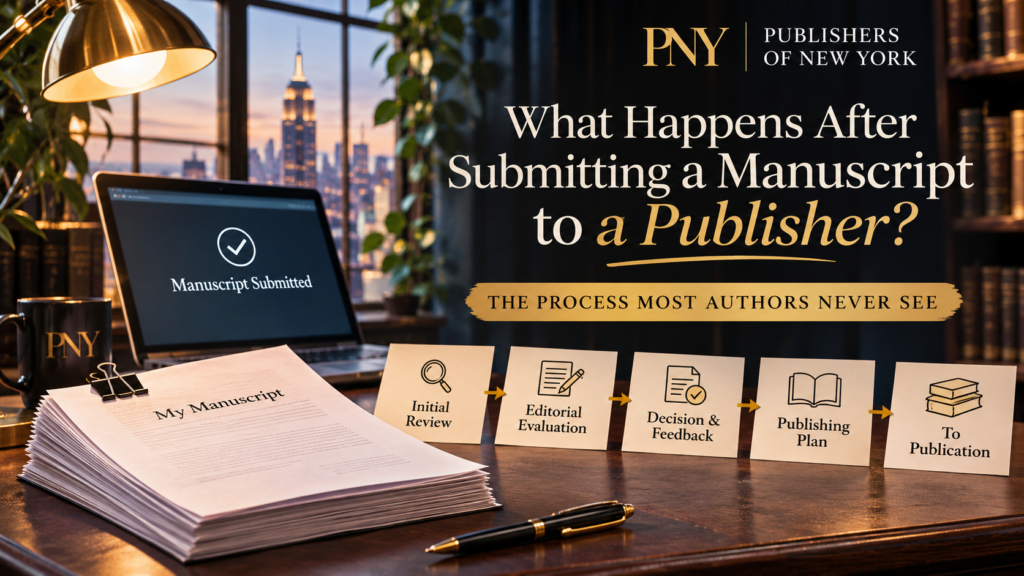
You spent months, perhaps years, writing your book. You revised chapters, questioned your opening, rewrote your ending, and finally gathered the courage to send it out. But one question often follows immediately: what happens after submitting a manuscript?
You clicked Submit.
And then… silence.
No immediate response. No insight into who’s reading your work. No indication of whether your story has caught someone’s attention or is still waiting to be reviewed.
For many authors, this is where the uncertainty begins.
What happens after submitting a manuscript to a publisher? Does someone immediately start reading? Do editors judge your book by its opening pages? And what exactly separates a manuscript that moves forward from one that doesn’t?
The truth is that publishing involves far more than receiving a document and deciding whether the writing is good.
Behind every serious publishing decision is an evaluation of storytelling, structure, audience, market potential, and the author’s vision for the book.
Understanding the manuscript submission process can help you approach publishers with realistic expectations, prepare stronger materials, and recognize what may happen after your book enters editorial consideration.
Let’s take a closer look at what happens behind the scenes, from the moment your manuscript arrives to the decisions that could shape its publishing future.
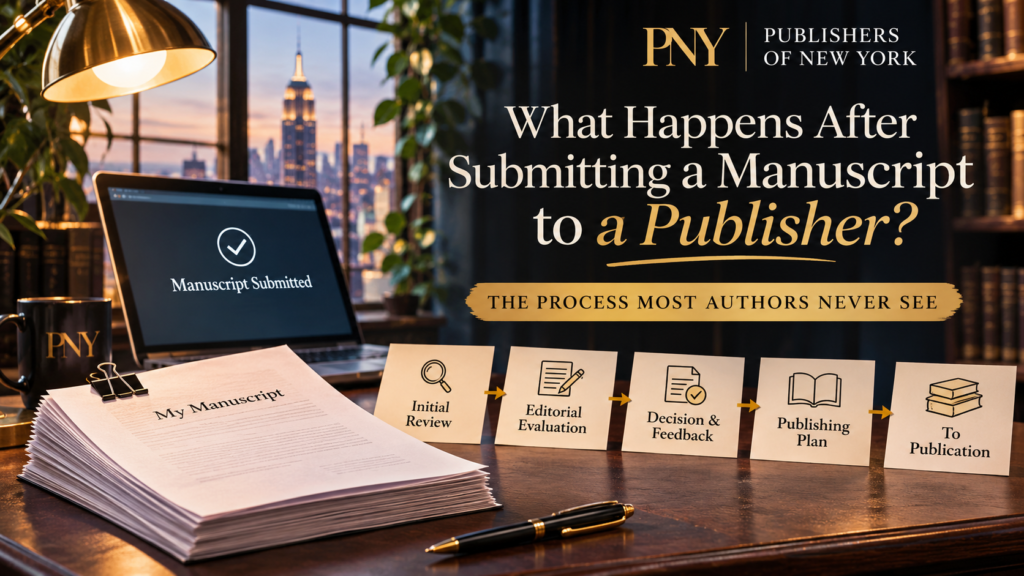
What Happens After Submitting a Manuscript? The Initial Review
The moment you submit your manuscript might feel like the finish line, but for a publisher, it marks the beginning of an evaluation.
Before anyone can make a meaningful publishing decision, the submission needs to be understood in context.
Publishers generally need to establish what kind of book they’ve received, whether it fits their interests, and whether the author has provided enough information for a proper review.
This is why submission guidelines matter more than many writers realize.
A publisher may request a synopsis, sample chapters, the full manuscript, an author biography, or information about the intended audience.
These materials aren’t simply administrative requirements. They help the publisher understand the project before making decisions about its potential.
For instance, a 90,000-word literary novel will be evaluated differently from a 35,000-word business guide. The two books serve different audiences, follow different conventions, and may require different editorial approaches.
At Publishers of New York, authors are asked to provide a concise book overview, sample chapters or a full manuscript, approximate word count, author background, and publishing goals.
The information provides essential context for editorial consideration.
What authors should understand: The manuscript submission process begins before an editor evaluates the quality of your prose. The completeness and clarity of your submission help establish whether the book is suitable for further consideration.
Sending the correct materials demonstrates professionalism and allows attention to remain where it belongs: on your book.
2. Who Actually Reads Your Manuscript?
It’s one of the questions authors are most curious about.
After submitting your manuscript, whose hands does it reach?
The answer varies depending on the publisher.
Large traditional publishing houses may rely on literary agents to introduce manuscripts to acquiring editors. Some publishers accepting direct submissions have editorial assistants, readers, or other team members involved in initial evaluations.
Smaller independent publishing companies may organize their review process differently, sometimes involving senior editors or publishing decision-makers more directly.
There is no single universal system.
What matters is that the people evaluating a submission understand the book’s genre, intended readership, and editorial requirements.
An editor considering a suspense novel may examine its central conflict, narrative tension, pacing, and character motivation.
An editor reviewing a memoir may pay closer attention to narrative coherence, emotional authenticity, and the relationship between personal experience and reader engagement.
For nonfiction, the evaluation could involve the author’s expertise, organization of ideas, originality, and the relevance of the subject to its intended audience.
This is where editorial review becomes more than simply reading for enjoyment.
An editor isn’t only asking, “Do I like this book?”
They may also be asking:
- Does the manuscript accomplish what it intends to accomplish?
- Is there a clearly identifiable audience?
- What makes the book distinctive?
- Are its weaknesses manageable through editing?
- Does the project fit the publisher’s interests and capabilities?
At Publishers of New York, the submission guidelines state that manuscripts are evaluated by the editorial team for story, voice, market potential, and alignment with the company’s mission.
The goal is to assess the manuscript thoughtfully rather than treat every submission as an interchangeable product.
The important distinction: A positive editorial evaluation depends on more than personal taste. It considers the book as both a creative work and a potential publication.
3. What Do Publishers Look for in a Manuscript?
Every author wants to know the answer to this question.
Is it the writing? The story? The genre? The possibility of commercial success?
In practice, what publishers look for often involves a combination of these elements.
A manuscript doesn’t necessarily need to be flawless to demonstrate potential. But it does need to offer a convincing reason for further consideration.
Here are five qualities that frequently matter during the evaluation.
A Distinctive Voice
Voice is one of the qualities that can make a manuscript memorable.
Two authors might explore the same subject, but their perspectives, language, emotional insight, and storytelling choices can produce entirely different books.
Publishers often value writing that feels authentic rather than merely imitative.
A Strong Central Idea
A manuscript should have a recognizable purpose.
For fiction, that purpose may emerge through its central conflict, characters, or themes. For nonfiction, it may involve an important argument, useful knowledge, or a fresh perspective on a familiar subject.
The clearer the idea, the easier it becomes to understand the book’s potential readership.
Effective Structure and Development
A promising concept can lose its impact if the manuscript lacks coherence.
Editors consider how chapters connect, how ideas develop, and whether the reading experience remains engaging from beginning to end.
A strong opening matters, but sustained execution matters too.
A Defined Audience
Not every book needs to appeal to everyone.
A thoughtful literary novel may target a relatively specific readership, while a practical personal development book may address a more clearly defined problem.
Knowing who the book is intended for helps publishers evaluate positioning, presentation, and marketing possibilities.
Editorial and Market Potential
Finally, publishers consider whether the manuscript can be developed into a compelling finished book.
This is where understanding what publishers look for becomes especially valuable.
A manuscript may have weaknesses but still demonstrate a powerful voice, an original perspective, or a story worth developing.
Likewise, technically polished writing may struggle to move forward if its overall concept lacks direction or doesn’t fit the publisher’s program.
A professional manuscript assessment helps distinguish between problems that can be improved through editing and larger questions about the book’s suitability for a particular publishing path.
4. Why Do Publishers Reject Manuscripts That Seem Good?
Here’s something many authors discover only after receiving a rejection: a good manuscript isn’t automatically the right manuscript for every publisher.
A rejection can feel deeply personal.
After spending years developing a book, receiving an unfavorable response may seem like a judgment of your ability as a writer.
But publishing decisions involve factors beyond the quality of the writing.
A manuscript may be declined because it doesn’t match the publisher’s editorial direction, falls outside its preferred genres, targets a readership the company doesn’t serve, or requires more development than the publisher is prepared to undertake.
Sometimes a publisher may already have similar books in its catalog or upcoming publishing plans. In other cases, the manuscript may show promise but still contain significant structural problems.
For example, imagine a historical novel with an intriguing setting and an original premise. The dialogue is convincing, the research is thorough, and the characters are memorable. However, the central conflict doesn’t emerge until halfway through the book, and the ending resolves several important storylines too quickly.
The manuscript may have strong individual elements without yet delivering a satisfying complete experience.
An editorial review could identify those issues and recommend substantial revisions. But not every publisher will have the resources, interest, or capacity to develop that particular project.
This explains why understanding what publishers look for is only part of the equation. Authors must also understand the concept of publishing fit.
A rejection doesn’t automatically mean your book lacks value. It means that particular publisher has decided not to move forward with it. That distinction can help authors respond constructively rather than abandon a worthwhile project.
5. What Happens After Submitting a Manuscript If a Publisher Sees Potential?
Now imagine a different outcome.
Your manuscript has been reviewed, and the publisher sees something worth exploring.
Perhaps the story has an unusual perspective. Perhaps your nonfiction manuscript addresses an underserved audience. Or perhaps your writing has a distinctive voice that could become even stronger through careful editing.
What happens next?
Depending on the publishing model, a positive initial evaluation may lead to a request for more material, further editorial discussion, a revision request, or a conversation about potential publication.
It doesn’t necessarily mean that a publishing agreement is guaranteed. The next step is often a closer examination of the manuscript’s needs and the author’s goals.
This may include a manuscript assessment designed to clarify the book’s strengths, identify editorial concerns, and determine the work required before publication.
For example, a publisher might recognize that a memoir contains powerful personal experiences but needs clearer chronology. A nonfiction manuscript might offer valuable knowledge but require a more accessible chapter structure. A novel might have a compelling premise but benefit from deeper character development.
These are editorial challenges, not necessarily reasons to discard the project.
At Publishers of New York, the stated process begins with editorial consideration and feedback.
When a project is suitable, the team may discuss next steps and develop a publishing plan tailored to the manuscript and the author’s objectives.
This collaborative approach recognizes that books can enter the publishing process at different stages of development.
Some manuscripts may be close to production-ready. Others require more extensive editorial work.
The most useful outcome is a realistic understanding of the book’s current condition and what it would take to move forward.
6. From Editorial Review to a Publishing Plan
One of the most significant transitions in a book’s journey occurs when an editorial evaluation becomes a practical publishing strategy.
At this stage, the discussion shifts from Does this manuscript have potential? to What would be required to publish it effectively?
A professional publishing plan may consider editing, book design, production formats, distribution, marketing, timelines, and the author’s financial expectations.
This doesn’t mean every book needs every available service.
A manuscript with strong structure and polished writing may require a different level of editorial support from one undergoing substantial developmental revision.
Similarly, a heavily illustrated children’s book may have production requirements that differ considerably from those of a text-only novel.
An effective publishing process recognizes these distinctions rather than applying the same approach to every project.
The editorial findings provide the foundation for these decisions.
If the manuscript assessment identifies major structural concerns, developmental editing may need to happen before copyediting or design.
If the text is already well developed, the project may be ready for more detailed editorial refinement and production planning.
Authors should also understand the financial and contractual side of publication.
Depending on the publishing model, the publisher may finance production, the author may purchase publishing services, or another agreed arrangement may apply.
These distinctions should be clear before an author commits.
At Publishers of New York, the published process describes a customized plan covering editorial and production requirements, selected services, timelines, milestones, and investment.
Agreement and onboarding follow once the parties decide to proceed.
A thoughtful plan gives the author a clearer picture of the work ahead.
Publication shouldn’t begin with uncertainty about the services being provided, the rights involved, or the responsibilities of each party.
7. What Happens After Submitting a Manuscript? How Long the Review Takes
Here’s the question that can make even experienced authors impatient:
When will I hear back?
Once a manuscript has been submitted, the waiting period can feel unusually long.
Every day without a response may raise new questions. Has the publisher received it? Is someone reading it? Does the delay mean the book has been rejected?
In reality, response times vary considerably.
Some publishing companies provide estimated review periods. Others accept submissions only during designated windows or have policies explaining when authors should assume a project is no longer under consideration.
The length of the manuscript submission process can depend on submission volume, manuscript length, internal capacity, and the publisher’s review procedures.
At Publishers of New York, the published submission guidelines state that authors can typically expect a response within 2–4 weeks, although timing may vary.
The guidelines also request that authors avoid sending follow-up emails during that initial review period.
This is an important detail because submission policies are not identical across publishers.
Before submitting, authors should always check the publisher’s stated timeline and follow-up instructions.
It’s also important to distinguish between the initial review and the complete publishing process.
Receiving an encouraging response doesn’t mean the book will be printed within days.
Editorial development, design, proofing, distribution setup, and launch preparation may require additional time.
For authors wondering what happens after submitting a manuscript, Understanding what happens after submitting a manuscript becomes especially important when a publisher sees potential and begins considering the next stage.the most useful approach is to view the initial waiting period as one stage within a larger sequence of decisions.
A delayed response, by itself, is not reliable evidence of acceptance or rejection.
8. What Happens After Submitting a Manuscript While You Wait for a Response?
Submitting your manuscript doesn’t mean your work as an author has to stop.
In fact, the waiting period can be one of the most productive opportunities to prepare for what comes next.
The key is to focus on activities that strengthen your publishing readiness without disregarding the publisher’s submission policies.
Review Your Author Biography
Your author biography helps explain who you are and why readers might connect with your work.
Consider whether it clearly communicates your relevant experience, writing interests, and connection to the subject of your book.
Understand Your Target Readership
Think beyond general statements such as “my book is for everyone.”
Who is most likely to enjoy or benefit from your work? What other books are those readers purchasing? What expectations might they have?
Understanding the audience can help with future positioning and marketing decisions.
Research the Business of Publishing
Learn the differences between publishing models, copyright ownership, distribution arrangements, royalty structures, and author responsibilities.
If you receive a publishing proposal, this knowledge can help you evaluate it with greater confidence.
Prepare Thoughtful Questions
If a publisher expresses interest, you may want to ask about editing, production timelines, author approvals, pricing, marketing, distribution, and contractual terms.
You don’t need to become an industry expert overnight, but you should understand the commitments you’re considering.
Respect Submission Guidelines
Some publishers permit simultaneous submissions. Others do not.
Publishers of New York currently asks authors not to submit manuscripts that are under active consideration elsewhere.
Following the guidelines is part of maintaining a professional relationship.
Understanding what happens after submitting a manuscript also means knowing when to communicate and when to allow the publisher’s stated review period to run its course.
The waiting period is not necessarily wasted time. It can help you become better prepared for the decisions that follow.
9. What Happens After Submitting a Manuscript When It Is Accepted?
Acceptance is an exciting milestone, but it doesn’t mean the book is ready to appear on bookstore shelves.
Depending on the publisher, acceptance may first lead to contract negotiations, further editorial planning, or confirmation of the book’s publishing schedule.
Once the parties have agreed to the terms, the project can move into the appropriate production stages.
The exact sequence varies, but several activities are common.
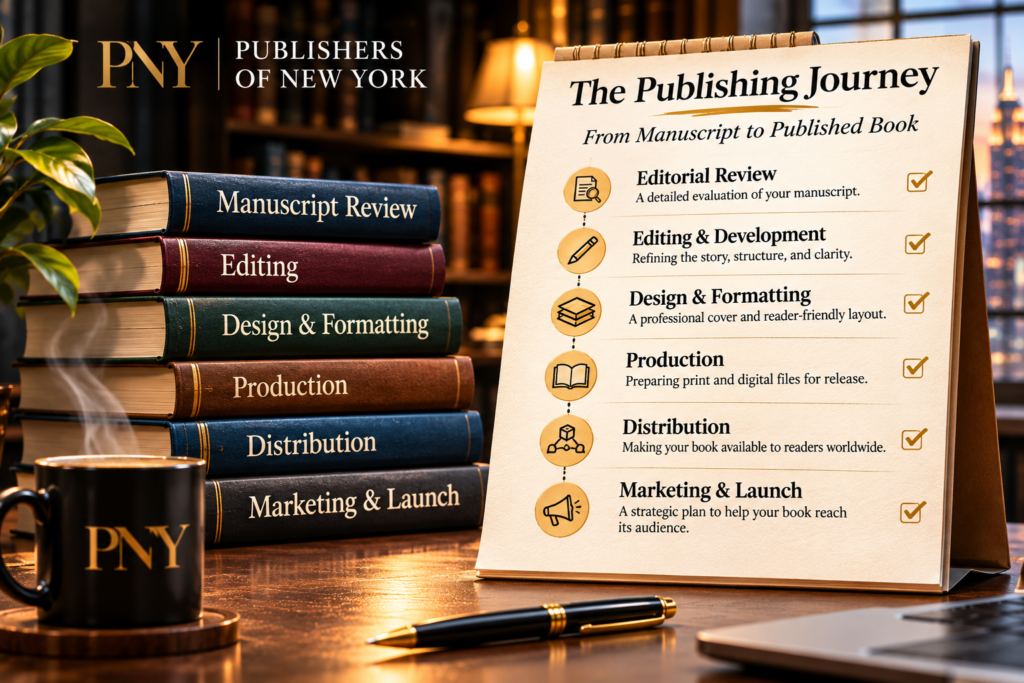
Editing and Manuscript Development
At this point, what happens after submitting a manuscript shifts from evaluation into the practical work of preparing the book for publication.The book may undergo developmental editing, line editing, copyediting, and proofreading, depending on its needs.
This is where earlier editorial review findings become especially useful.
A well-defined editorial direction helps preserve the author’s voice while improving the manuscript’s clarity, structure, and overall effectiveness.
Cover Design and Interior Formatting
Once the manuscript is sufficiently developed, attention turns to the visual presentation.
Cover design should communicate the book’s genre, tone, and intended readership.
Interior formatting prepares the pages for print or digital reading while addressing readability and technical requirements.
Proofing and Author Approval
Authors may review edited text, cover concepts, and production files before final publication.
Depending on the agreement and workflow, revisions and approvals help ensure that the finished book accurately reflects the intended content.
Distribution Preparation
The publisher or publishing service provider prepares the book for its selected sales channels.
This can involve ISBNs, metadata, categories, keywords, pricing, and files that meet retailer or distributor requirements.
Publication and Marketing
A book becoming available for purchase is an important achievement, but availability alone does not guarantee discovery.
Marketing may involve author branding, publicity outreach, advance reader copies, social media, advertising, and launch activities.
The goal is to help the book reach readers who are most likely to value it.
The Publishers of New York Publishing Process outlines its approach to editorial development, production, author approval, distribution, publication, and ongoing support.
A professional publishing process should provide authors with clarity about each stage and its requirements rather than leaving them uncertain about what happens next.
10. Frequently Asked Questions: What Happens After Submitting a Manuscript?
Even after understanding the stages of publishing, authors often have practical questions about what to expect.
Do publishers read every manuscript they receive?
Review practices vary.
Some publishers use screening procedures, while others have editorial teams evaluate submissions directly.
Publishers of New York states that its editorial team evaluates submissions for story, voice, market potential, and alignment with its mission.
Authors should not assume every publisher follows the same procedure or reads every page during an initial evaluation.
Will a publisher tell me why my manuscript was rejected?
Not necessarily.
Some publishers provide detailed feedback, while others send standard decisions or do not offer individual explanations.
If feedback is available, it can help authors identify potential improvements, but the level of detail depends on the publisher’s policy.
Can I submit an unfinished manuscript?
Requirements vary by publisher and type of book.
Many fiction publishers prefer completed manuscripts, while certain nonfiction projects may be considered from proposals.
Publishers of New York accepts sample chapters or complete manuscripts alongside the requested supporting information, although completed work is generally preferred for comprehensive evaluation.
Does a positive manuscript assessment guarantee publication?
No.
A favorable manuscript assessment may indicate that a book has promise, but publication depends on further decisions about editorial fit, terms, resources, and the publishing arrangement.
How can I improve my chances of receiving serious consideration?
Submit a complete, carefully prepared package, follow the guidelines, identify your audience, and present a compelling manuscript.
Understanding what publishers look for can help you focus on the qualities that matter most: clear writing, meaningful content, distinctive perspective, and a well-developed concept.
What happens after submitting a manuscript if the publisher wants to move forward?
The publisher may contact you to discuss feedback, the book’s goals, an agreement, editorial requirements, and potential next steps.
At Publishers of New York, projects that are a suitable fit may proceed toward a customized publishing plan.
Your Manuscript Deserves More Than an Automatic Response
Behind every submitted manuscript is an author who has invested time, imagination, and determination into creating something meaningful.
That work deserves thoughtful consideration.
But understanding what happens after submitting a manuscript is about more than satisfying curiosity.
It’s about recognizing that publishing involves editorial judgment, practical planning, and decisions that can shape the future of your book.
The journey from manuscript to published work isn’t always straightforward.
Some books need further development. Others may be ready to progress toward production. And not every publisher will be the right match for every story.
What matters is approaching the process with realistic expectations and a clear understanding of your options.
At Publishers of New York, we believe books deserve more than production. They deserve careful evaluation, thoughtful editorial guidance, and a publishing approach that respects the author’s voice.
Whether you’ve written your first novel, completed a memoir, or developed a nonfiction book with an important message, the next step begins with understanding your manuscript and its potential.
Ready to discover what comes next for your book?
Submit your manuscript to Publishers of New York for editorial consideration and take the next step toward bringing your work to readers.
Every published book begins with a manuscript. What happens next can make all the difference.