
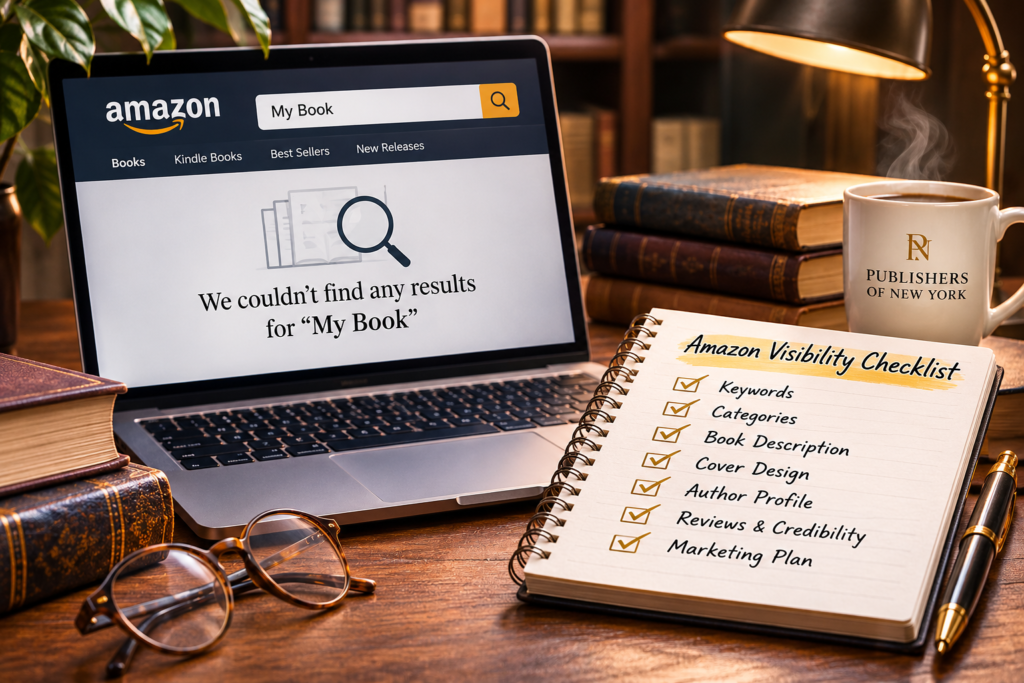
Why is my book not showing up on Amazon? That question often comes after an author publishes a book, shares the news, and then realizes very few readers are actually discovering it.
You’ve shared the exciting news, your book is available on Amazon, and your cover looks professional.
But as the days turn into weeks, something frustrating happens.
Very few people are discovering your book.
You search for it yourself, and it barely seems to exist unless you type the exact title.
So you start wondering: Why is my book not showing up on Amazon?
Here’s what many first-time authors discover too late: being available on Amazon does not automatically mean readers will discover your book.
Being listed on one of the world’s largest online bookstores does not guarantee visibility, traffic, or sales.
Thousands of other books are competing for attention. Even a well-written book may struggle to reach its intended audience without the right keywords, categories, positioning, metadata, and marketing strategy.
The good news is that many Amazon book visibility problems can be identified and improved.
Let’s explore ten mistakes that may be affecting your book discoverability, along with practical ways to help the right readers find your work.
1. Why Is My Book Not Showing Up on Amazon? Check Searchability First
Before worrying about marketing, confirm that your book is properly listed.
If you’re asking, “Why is my book not showing up on Amazon?”, the issue may be technical rather than promotional.
According to Amazon KDP, newly published books can take time after going live to appear in search results.
Availability may also vary by marketplace and distribution region.
Start by checking whether your book is accessible through its direct product link.
Review the status of your publication in your KDP Bookshelf.
Then search using the exact book title and author name within the Books or Kindle Store category.
If the expected processing period has passed and the book still cannot be found, contact your publishing platform or distributor.
Remember: A missing listing and a poorly performing listing are two different problems.
Identify which one you are dealing with before making marketing changes.
2. Your Amazon Keywords Aren’t Helping Readers Find You
Imagine publishing a historical romance but using broad keywords such as:
- Love
- Fiction
- Novel
Those terms describe thousands of books.
They do very little to communicate what makes your book distinctive.
Effective Amazon book keywords should reflect the language readers might use when searching for a particular type of book.
For example, a historical romance involving a second-chance relationship might benefit from more specific phrases that reflect the period, setting, relationship dynamic, or themes.
When setting up a book through Amazon KDP, authors can enter keyword information designed to help describe the book.
The goal is not simply to select the most popular words.
The goal is to choose relevant, accurate search phrases.
How to Improve
Research how readers describe books similar to yours.
Look at comparable titles and consider:
- Genre
- Subgenre
- Setting
- Themes
- Character types
- Reader interests
- Problems your nonfiction book solves
Reviewing your Amazon book keywords periodically can become a useful part of improving long-term book discoverability.
3. You’ve Chosen the Wrong Book Categories
Book categories help Amazon and potential readers understand where your title belongs.
Imagine placing a psychological thriller in a category unrelated to suspense or crime.
The result may be confusion rather than greater exposure.
Similarly, choosing a category that is extremely broad can make it harder for readers interested in your specific subgenre to recognize your book.
Accurate categories support book discoverability by connecting your title with relevant browsing interests.
How to Improve
Examine your:
- Primary genre
- Subgenre
- Themes
- Target audience
- Comparable books
Then compare the books appearing in your selected categories with titles that genuinely share your audience and subject matter.
Avoid choosing misleading categories simply because they appear less competitive.
A ranking that reaches the wrong audience is less valuable than visibility among readers who are genuinely interested in your book.
4. Your Book Description Isn’t Convincing Readers
Finding your book is only half the challenge.
Convincing someone to explore it is the next step.
Even when your Amazon book visibility improves, a weak description can still limit reader interest.
Common problems include:
- Revealing too much of the plot
- Starting with generic praise
- Failing to explain what makes the book interesting
- Using long blocks of text without a clear hook
- Speaking too broadly about the book’s audience
For fiction, focus on the central conflict, stakes, atmosphere, and emotional appeal.
For nonfiction, explain the problem your book addresses and the value readers can expect to receive.
How to Improve
Begin with a compelling hook.
Establish the book’s promise.
Then give readers a reason to keep exploring.
Effective book metadata optimization includes making sure your description is clear, accurate, engaging, and aligned with your intended readership.
5. Your Cover Looks Good but Doesn’t Fit Your Genre
A beautiful cover is not automatically an effective cover.
Imagine a suspense novel using imagery and typography that look more appropriate for a lighthearted romantic comedy.
The artwork may be attractive, but it can send the wrong message to readers.
Your cover should quickly communicate:
- Genre
- Tone
- Audience expectations
- Professional quality
This becomes even more important when readers encounter the cover as a small online thumbnail.
How to Improve
Compare your cover with professionally presented books in your category.
Ask:
- Can readers identify the genre?
- Is the title readable at thumbnail size?
- Does the imagery reflect the actual content?
- Does the design feel appropriate beside comparable books?
A well-positioned cover can help turn browsing attention into meaningful interest.
For more guidance, explore the Publishers of New York publishing process, which explains how professional design fits into the broader book production journey.
6. Your Author Profile Is Incomplete
Before purchasing a book, readers may want to know more about the person who wrote it.
An incomplete author profile can become a missed opportunity to build trust.
Eligible authors can use Amazon Author Central to connect books, add a biography, maintain an author page, and present a more consistent identity.
A professional photograph, concise biography, connected titles, and consistent branding can make your author presence feel more established.
How to Improve
Review your Amazon Author Central profile and make sure the information is accurate and current.
Check:
- Author photograph
- Biography
- Connected titles
- Name consistency
- Website information
- Social presence
Maintain consistency between your Amazon presence, author website, and other public platforms.
An author profile is not a guaranteed ranking factor, but it can support reader confidence and long-term discoverability.
Authors building a broader publishing presence can also explore the Publishers of New York Author Resources for guidance on the publishing journey.
7. You Have Little or No Reader Feedback
Think about the last time you purchased something online.
Did you read the reviews?
Many book buyers do the same.
Genuine reader feedback can help potential buyers understand what other readers appreciated about a book.
A title with very little feedback may have fewer opportunities to demonstrate reader interest.
However, reviews should never be purchased, fabricated, or exchanged for misleading incentives.
How to Improve
Encourage genuine reader responses through appropriate channels such as:
- Advance reader initiatives
- Reader communities
- Post-publication outreach
- Author newsletters
- Book launch campaigns
Follow Amazon’s review policies and avoid pressuring readers to provide only positive feedback.
Reviews do not guarantee success.
They help build reader confidence.
If you’re exploring how to increase book visibility, focus on reaching relevant readers rather than simply collecting ratings.
8. You’re Relying on Amazon to Do All Your Marketing
Publishing your book is not the same as promoting it.
Amazon provides a marketplace, but that does not guarantee that your title will receive significant attention.
Many authors assume that once the book goes live, readers will naturally discover it.
That is rarely a complete marketing strategy.
Building awareness may involve:
- Social media content
- Email marketing
- Author interviews
- Reader communities
- Publicity outreach
- Advertising
- Author branding
- Launch campaigns
The most effective combination depends on your genre, audience, goals, and budget.
How to Improve
Identify where your potential readers spend their time.
Then create a realistic promotional strategy around those channels.
Learning how to increase book visibility means creating opportunities for readers to discover your work both on Amazon and elsewhere.
At Publishers of New York, the broader publishing process can include audience positioning, production planning, distribution, and launch preparation.
9. Why Is My Book Not Showing Up on Amazon? Check Your Metadata
Why is my book not showing up on Amazon even though you have already selected keywords and categories?
Sometimes the problem lies in how the information surrounding your book works together.
Book metadata can include:
- Title
- Subtitle
- Author name
- Description
- Categories
- Keywords
- Pricing
- Format information
These details help retailers organize, understand, and present your book.

Effective book metadata optimization is not about inserting search phrases everywhere possible.
The information should be coherent, relevant, and consistent with the actual book.
For example, a nonfiction title positioned as a practical leadership guide should have a description, categories, and keywords that reinforce that identity.
How to Improve
Audit your metadata as one complete package.
Review your Amazon book keywords.
Confirm that your categories remain relevant.
Check the description.
Verify that the author name, title, subtitle, and other details match the published edition.
Thoughtful book metadata optimization can improve how clearly your book is presented, although no metadata strategy can guarantee a particular search position.
10. How to Increase Book Visibility and Reach the Right Readers
If you’re still wondering, “Why is my book not showing up on Amazon?”, start by addressing the factors you can control.
Improving visibility does not always require a complete relaunch.
Sometimes better positioning, a more precise category, clearer metadata, or a stronger promotional strategy can make a meaningful difference.
Here is a simple action plan:
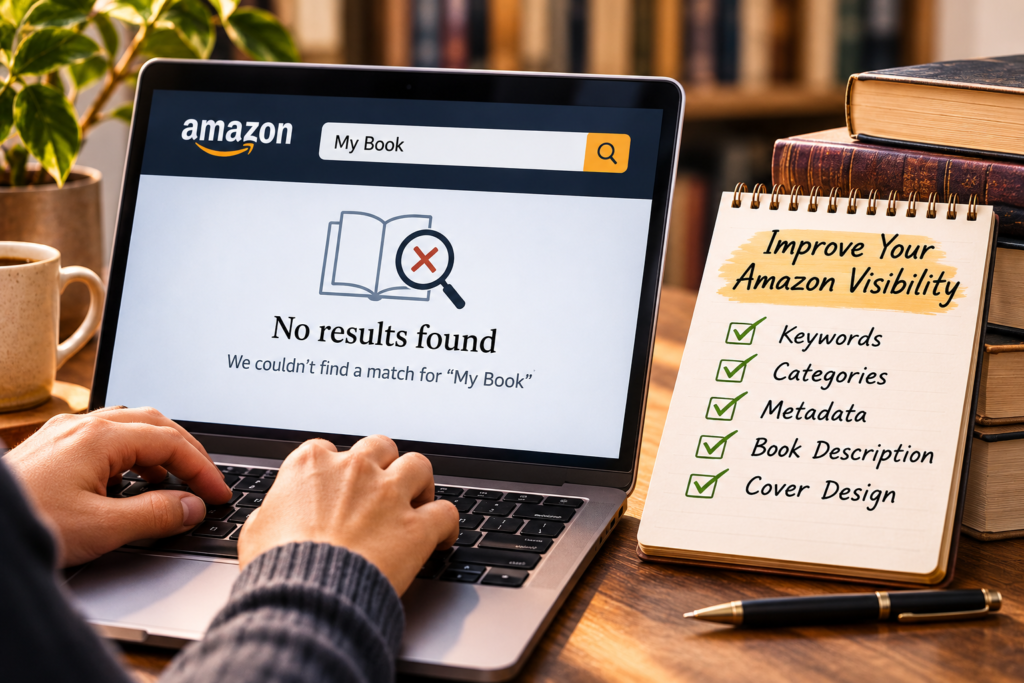
1. Verify Your Listing
Confirm that the book is live, searchable, and available in your intended marketplace.
2. Review Your Keywords
Replace vague or irrelevant phrases with accurate, reader-focused terms.
3. Evaluate Your Categories
Make sure the book appears in browsing sections appropriate to its genre, content, and audience.
4. Improve Your Presentation
Review your cover, description, author profile, and overall book page.
5. Build a Promotional Strategy
Reach readers through channels that fit your book and audience.
Understanding how to increase book visibility also means accepting that results can take time.
Search placement can be influenced by several factors, and no publisher or marketer can guarantee a specific organic ranking.
Your Book Deserves to Be Discovered
Writing and publishing a book requires commitment.
But making that book discoverable is another important part of reaching readers.
The difference between an available book and a discoverable book often comes down to thoughtful positioning, accurate metadata, strong presentation, and consistent marketing.
Strong Amazon book visibility is not about trying to reach every possible reader.
It is about helping the right readers recognize a book they may genuinely want to explore.
And improving book discoverability is not a one-time task.
It is part of building a lasting author presence.
At Publishers of New York, we understand that publishing does not end when a book goes live.
Our approach considers the journey from manuscript development and professional production to distribution and launch preparation.
Whether you are preparing your first book or planning your next publication, thoughtful decisions made early can help create a stronger foundation for reaching readers.
Explore our publishing process or submit your manuscript for editorial consideration.
Because publishing your book is an achievement.
Helping readers discover it is the next chapter.