
Can someone steal your book idea after you share your manuscript with a publisher, editor, or another reader? It is a concern many first-time authors have before submitting their work.
The characters, plot twists, emotional moments, and final conclusion all came from your imagination.
Then someone asks to read your manuscript.
Suddenly, an uncomfortable thought appears:
What if someone steals my idea?
Some authors become hesitant to approach publishers, share their work, or even discuss their books publicly because of this fear.
The important truth is that copyright law does not protect general book ideas in quite the way many authors assume.
So, can someone steal your book idea and turn it into their own published story?
The answer is more complicated than a simple yes or no.
Understanding copyright for authors is important before sharing a manuscript. Original writing can receive legal protection, but there are also limits to what copyright covers.
Let’s separate the myths from the facts and look at how to protect your book idea, manuscript, and rights as an author.
1. Can Someone Steal Your Book Idea? What Copyright Actually Protects
Imagine two authors writing stories about a young woman who discovers a secret world beneath her city.
The concept sounds remarkably similar.
Does that automatically mean one writer copied the other?
Not necessarily.
Under U.S. copyright law, general ideas, concepts, and themes are not protected in the same way as an author’s original expression.
The distinction between an idea and its original expression is fundamental to book copyright protection.
Another author may independently create a story based on a similar general concept without necessarily infringing copyright.
Legal concerns may arise when protected passages or other sufficiently original expressive elements are copied.
So, can someone steal your book idea without copying your actual writing?
Someone may be able to use a similar general concept lawfully.
The more important legal question is whether protected creative expression has been copied.
For this reason, understanding copyright is often more useful than simply trying to keep every idea secret.
2. The Biggest Copyright Myth Authors Believe
One of the most common misconceptions among aspiring authors is that a manuscript must be formally registered before it receives any copyright protection.
That is generally not how U.S. copyright law works.
According to the U.S. Copyright Office, eligible original works receive copyright protection once they are created and fixed in a tangible form, such as a written manuscript.
The book does not need to be published first.
You also do not necessarily need to finish the entire manuscript before copyright exists in the eligible material you have already created.
However, formal registration can provide important legal benefits.
For authors researching how to copyright a book, the distinction is important:
Copyright protection and copyright registration are not the same thing.
Eligible original writing may receive copyright protection automatically once it is fixed in tangible form.
Registration creates an official public record and may provide additional advantages when enforcing rights.
Understanding this distinction is an important part of copyright for authors, particularly before entering a publishing agreement.
3. What’s Actually Protected: Your Idea or Your Writing?
Let’s make the distinction clearer.
Suppose you write a mystery about a detective in a seaside town investigating a series of disappearances.
You do not automatically own the basic concept of a detective investigating disappearances in a coastal setting.
Another writer could independently create a mystery with similar broad circumstances.
What may be protected is your original expression, including sufficiently creative:
- Written scenes
- Dialogue
- Descriptions
- Narrative language
- Original literary expression

This is where book copyright protection becomes meaningful.
Generally Not Protected by Copyright
- General story ideas
- Broad themes
- Familiar plot concepts
- Basic historical facts
- Book titles by themselves
Potentially Protected
- Original written passages
- Original dialogue
- Original expressive descriptions
- Creative expression involving factual material
- Original literary content
More complicated legal questions can arise around fictional characters, detailed plot elements, and other distinctive creative material.
But the basic principle remains the same:
Others may use similar ideas.
Copyright primarily protects your original creative expression.
When authors ask how to protect a book idea, one of the most practical steps is to develop that idea into original, documented creative work.
4. Should You Copyright Your Book Before Sending It to Publishers?
Your manuscript is finished.
Now you are preparing to submit it.
Should you register the copyright first?
Registration is not necessarily required for copyright protection to exist, but it can provide important legal benefits.
For U.S. works, registration or refusal by the Copyright Office is generally required before bringing a copyright infringement lawsuit in federal court.
Timing can also affect eligibility for certain statutory damages and attorney’s fees.
Because of this, authors may want to consider registration as part of their publication planning.
Authors researching how to copyright a book can apply directly through the official U.S. Copyright Office.
It is also wise to maintain records such as:
- Dated manuscript drafts
- Revision histories
- Backup copies
- Relevant correspondence
- Submission records
These materials do not replace copyright registration, but they can help document the development of your work.
The Key Takeaway
You do not need to purchase copyright protection from a publisher.
Instead, understand:
- Who owns your work
- What registration does
- What rights you may be licensing
- What the publishing agreement says
If you are preparing a manuscript for professional consideration, Publishers of New York’s publishing process explains how a project can move from editorial review toward publication.
5. Can Someone Steal Your Book Idea? Publish With Confidence
You discover a newly released book whose concept sounds remarkably similar to yours.
Same genre.
Comparable setting.
Perhaps even familiar character dynamics.
Your first reaction may be panic.
But similarity does not automatically mean manuscript theft.
Stories frequently share themes such as:
- Betrayal
- Redemption
- Survival
- Forbidden love
- Family secrets
- Revenge
- Identity
Legally, the important question is usually not whether two books share a broad concept.
The more important issue is whether protected original expression has been copied.
Before making accusations, examine the works carefully.
Ask whether the similarities involve distinctive original expression or simply familiar genre conventions.
If the similarities are substantial, professional legal review may be appropriate.
Understanding can someone steal your book idea also means recognizing that independent creation is possible.
Two writers can sometimes develop surprisingly similar concepts without either author having copied the other.
6. Can Publishers Legally Use Your Manuscript Without Permission?
Submitting your manuscript to a publisher does not automatically transfer your copyright to that publisher.
In typical submission situations, authors generally retain ownership unless they enter into an agreement that changes their rights.
However, publishing agreements may grant:
- Licenses
- Exclusive rights
- Distribution rights
- Format rights
- Territorial rights
- Other contractual interests
That is why copyright for authors should be understood before signing anything.
Review the agreement carefully and establish:
- Who owns the copyright?
- Which publishing rights are being licensed?
- How long does the agreement remain in effect?
- Which formats are included?
- What happens if the publishing relationship ends?
Under U.S. law, copyright transfers are generally required to be in writing and signed by the copyright owner, subject to applicable exceptions.
At Publishers of New York, the publishing process emphasizes author rights alongside editorial and publishing support.
However, authors should always review the specific agreement governing their individual project.
Clear terms, rather than assumptions, are the foundation of a professional publishing relationship.
7. How to Protect Your Manuscript Before Sharing It
Fear of manuscript theft should not prevent authors from pursuing legitimate publishing opportunities.
Instead, take reasonable precautions before sharing your work.
Here are five practical steps for writers researching how to protect a book idea.
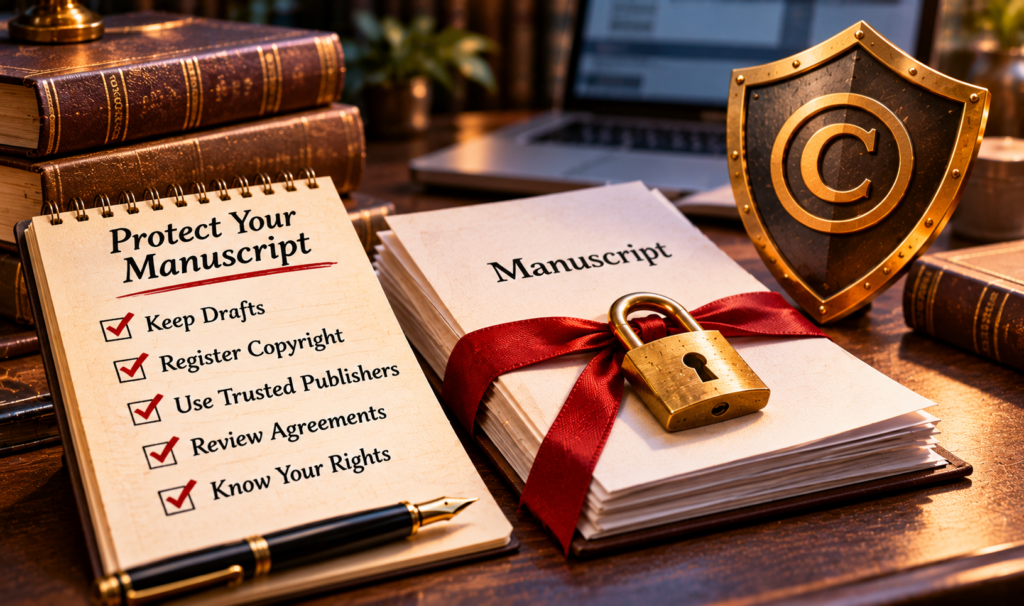
1. Keep Your Original Drafts
Maintain dated versions and secure backups showing the development of your manuscript over time.
2. Research Publishers Carefully
Review:
- Official websites
- Submission requirements
- Company information
- Publishing model
- Contractual terms
- Professional reputation
3. Use Established Submission Channels
Send your manuscript through official websites or verified professional contacts.
Avoid submitting sensitive material through unverified communication channels.
4. Consider Copyright Registration
Understand the benefits of registration and whether it is appropriate for your work and circumstances.
5. Review Agreements Before Signing
Pay close attention to:
- Ownership
- Licensing
- Exclusivity
- Royalties
- Duration
- Termination provisions
- Rights reversion
These precautions cannot eliminate every possible risk.
However, they can help authors approach the submission process with better organization and greater awareness.
Strong book copyright protection begins with understanding your rights, not assuming that every unfamiliar publisher is a threat.
Authors who are ready to approach a publisher can submit a manuscript to Publishers of New York through the official submission process.
8. What Should You Do If Someone Steals Your Work?
Discovering that someone may have copied your manuscript can be frightening.
However, immediately making public accusations may make the situation more difficult.
If you suspect manuscript theft, begin by collecting evidence.
Save:
- Dated versions of the original manuscript
- Relevant correspondence
- Submission records
- Website information
- Screenshots
- Copies of the allegedly infringing material
Then identify exactly what appears to have been copied.
Similar ideas alone may not establish infringement.
Specific passages or striking similarities in protected creative expression may require closer examination.
If the situation is serious, consider speaking with a qualified intellectual property attorney who can assess the evidence and explain your options.
Depending on the circumstances, those options might include contacting a platform, requesting removal of infringing material, using available copyright dispute procedures, or pursuing legal action.
The U.S. Copyright Office also provides information about copyright enforcement and the Copyright Claims Board.
The important point is to respond based on evidence and applicable law rather than assumption.
9. Five Copyright Mistakes First-Time Authors Should Avoid
Knowing how to copyright a book is useful.
Avoiding common misconceptions is equally important.
Mistake 1: Believing a Book Idea Alone Is Copyrighted
General ideas are not protected in the same way as original written expression.
Mistake 2: Assuming Registration Creates Copyright
Eligible original writing may receive copyright protection when it is created and fixed.
Registration provides an official record and additional legal benefits.
Mistake 3: Thinking an ISBN Protects Your Manuscript
An ISBN identifies a particular book edition or format.
It is not copyright registration.
Mistake 4: Signing Away Rights Without Understanding the Agreement
Publishing agreements differ.
Always review:
- Ownership
- Licensing
- Royalties
- Exclusivity
- Duration
- Termination
Mistake 5: Assuming Every Similar Story Is Plagiarism
Similarity alone does not automatically establish copyright infringement.
The analysis depends on what protected expression was allegedly copied and the specific circumstances involved.
Avoiding these mistakes gives authors a stronger foundation for protecting their work.
It also replaces uncertainty with more informed decision-making.
10. Your Story Is Yours: Publish With Confidence
So, can someone steal your book idea?
Someone may legally create a story based on a similar general idea.
Copying protected original expression can raise a very different legal issue.
Understanding that distinction can change how authors approach publishing.
You do not need to keep your manuscript hidden forever or avoid legitimate professional feedback because you are worried someone might discover your concept.
Instead:
- Understand your rights
- Document your creative work
- Consider registration
- Review contracts carefully
- Choose publishing partners thoughtfully
Effective book copyright protection means protecting your original creative expression while also understanding the limits of copyright law.
At Publishers of New York, we believe authors should approach publishing with clarity, confidence, and an understanding of their rights.
Our publishing process includes editorial development, professional production, distribution, and support designed to help authors move from manuscript to publication.
You can explore our publishing process or submit your manuscript for editorial consideration when you are ready to discuss the next stage.
Your imagination gives your story life.
Understanding your rights helps protect the work you create.
Disclaimer
This article provides general information about U.S. copyright law and is not legal advice. Copyright rules and enforcement requirements may differ across jurisdictions. Consult a qualified attorney for advice about your specific circumstances.