
Audiobook publishing can give your book a second life by helping it reach readers who prefer listening instead of reading.
It is available in paperback, hardcover, and eBook formats.
But what about people who haven’t picked up a physical book in months?
They may be listening instead.
Audiobooks give readers another way to experience stories during long drives, evening walks, morning commutes, workouts, and everyday routines.
If your book is available only in print or digital formats, you may be missing readers who prefer listening.
According to the Audio Publishers Association, U.S. audiobook sales reached $2.43 billion in 2025, continuing the format’s growth.
For authors willing to explore additional formats, that growth creates another opportunity to connect with audiences.
But is audiobook publishing worth the investment? Can it genuinely expand your audience, and what does the process involve?
Let’s explore five reasons to turn your book into an audiobook and give your words a second life.
1. Audiobook Publishing Helps Your Book Reach More Listeners
People experience books differently.
Some readers love turning physical pages.
Others prefer eBooks because of their convenience.
Then there are people who want to experience more books but struggle to find dedicated reading time.
This is where audiobooks become especially useful.
For example, someone may find it difficult to sit down with a novel after a demanding workday but happily listen to several chapters during the drive home.
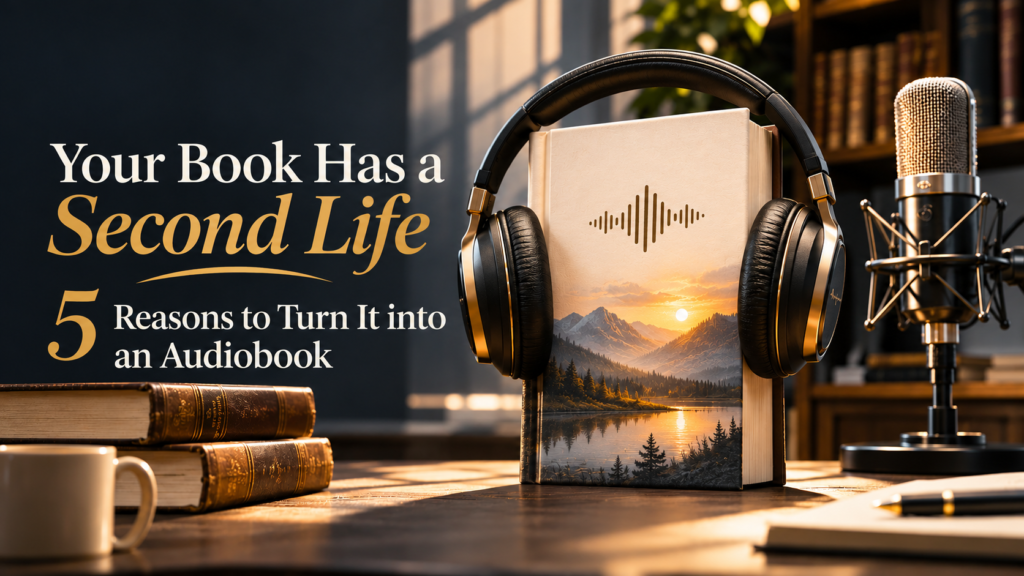
Another listener might experience a memoir while doing household chores or listen to nonfiction during a morning walk.
Audiobook publishing allows your story to become part of routines where traditional reading may not fit.
The Growing Audience for Audiobooks
Audiobooks continue to attract listeners who value convenience and multitasking.
That creates an important opportunity for authors.
People who are already interested in your genre or subject may still be outside your current audience simply because they prefer listening.
How Audiobooks Make Your Book More Accessible
Audiobooks can also provide an alternative format for people who find extended visual reading difficult.
Audio does not replace accessible digital text or other accommodations, but it gives readers and listeners another way to experience a book.
A professionally produced audiobook can make a novel, memoir, devotional, or educational title easier to enjoy when reading printed pages is not practical.
If you’re researching how to turn a book into an audiobook, start by thinking about your existing audience.
Ask:
- Would your readers enjoy listening while driving or commuting?
- Does your story contain dialogue that could become more immersive through narration?
- Could your nonfiction content work naturally in spoken form?
- Are readers already asking for an audio edition?
If the answer is yes, audiobook production may be worth exploring as part of your broader publishing process.
Your audience does not always need another book.
Sometimes they simply need another way to experience yours.
2. Professional Narration Can Bring Your Story to Life
Have you ever heard someone tell a story so well that you stopped noticing everything around you?
Their pauses created suspense. Tone and delivery communicated emotion, while careful timing made ordinary sentences memorable.
That is the power of a skilled storyteller.
When someone reads a printed novel, they interpret dialogue, character personalities, emotional changes, and pacing through their own imagination.
An audiobook introduces another storytelling element: the human voice.
But delivering a compelling audiobook performance is very different from simply reading a manuscript aloud.
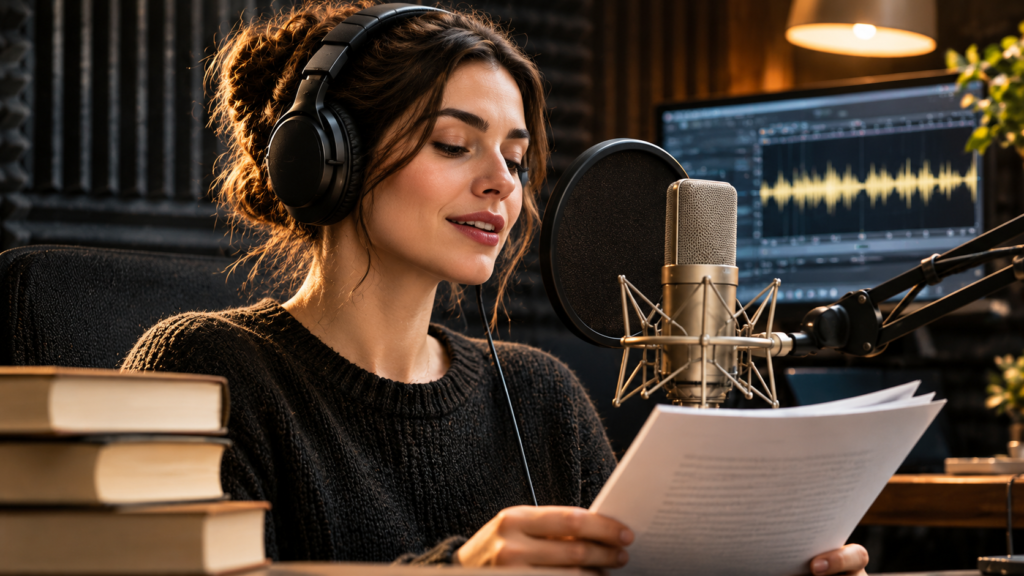
Why Professional Audiobook Narration Matters
Professional audiobook narration involves more than speaking clearly into a microphone.
A strong narrator considers:
- Characterization
- Emotional expression
- Pacing
- Pronunciation
- Tone
- Consistency
- Genre expectations
In fiction, narration can help differentiate dialogue and communicate shifts in mood.
In memoir, the right voice can preserve intimacy and authenticity.
In nonfiction, confident delivery can make complex ideas easier to follow.
The narrator should not overpower the writing.
The voice should complement it.
Imagine a suspenseful thriller narrated with no changes in pace, tension, or emotional emphasis.
Even an exciting scene might feel strangely flat.
Now imagine the same passage delivered with controlled pauses, tension, and emotional awareness.
The words have not changed.
The listening experience has.
Should You Narrate Your Own Book?
Some authors choose to narrate their own memoirs, personal stories, testimonies, or specialized nonfiction.
When an author’s personal experience or expertise is central to the book, hearing their actual voice can create a deeper connection with listeners.
However, self-narration still requires preparation.
Authors need to consider:
- Recording environment
- Microphone quality
- Vocal consistency
- Pronunciation
- Pacing
- Audio editing
- Technical requirements
In either case, professional audiobook production can support either approach through recording guidance, editing, mastering, and technical quality checks.
Before selecting a narrator, listen to performance samples and consider your genre, audience, and desired tone.
The right narrator does not replace your writing voice.
They help listeners experience it.
3. Audiobook Publishing Opens Another Revenue Opportunity
You have already invested time and resources into writing, editing, designing, and publishing your book.
So why limit its potential to only one or two formats?
Readers who prefer physical books may choose a paperback.
Digital readers may select an eBook.
Listeners may prefer an audiobook.
As a result, each format gives readers another way to purchase or access your work.
That does not mean every audiobook will become profitable.
It means audiobook publishing can create another commercial opportunity for an existing title.
How Do Authors Earn Money From Audiobooks?
Audiobook earnings depend on several factors, including:
- Distribution platform
- Contract terms
- Pricing structure
- Subscription or credit systems
- Royalty arrangements
- Territory
- Exclusivity
Some services sell audiobooks individually.
Others use subscription access or audiobook credits.
Before accepting distribution terms, authors should understand how compensation is calculated and how their rights are handled.
At the same time, production costs also matter.
Professional narration, recording, editing, mastering, and quality control all require investment.
A long novel with multiple narrators may involve a very different budget from a shorter nonfiction title.
Is Audiobook Production Worth the Cost?
Consider three important questions:
Audience demand: Are readers in your genre interested in audio editions?
Production budget: Can you afford professional production without compromising other publishing priorities?
Long-term goals: Does an audiobook support your broader author brand, future releases, or marketing strategy?
If readers are already requesting an audio edition, the investment may be easier to justify.
If your book is struggling to reach readers across every format, improving its positioning and promotion may need to come first.
Audiobook publishing should be part of a well-planned publishing strategy rather than an expensive attempt to solve unrelated marketing problems.
A new format creates an opportunity, not a guarantee.
The goal is to expand your book’s potential responsibly.
4. Audiobook Publishing Can Expand Your Distribution
Producing an audiobook is only one part of the process.
Making it available through suitable listening platforms is equally important.
Authors already consider retailers and distribution when publishing print books and eBooks.
Audiobooks require the same level of planning.
Depending on the chosen distributor, eligibility, territory, and agreement terms, audiobook destinations may include services such as Audible, Spotify, and Apple Books.
Understanding Audiobook Distribution
Audiobook distribution generally involves preparing and submitting:
- Completed audio files
- Audiobook cover artwork
- Book metadata
- Author and narrator information
- Pricing or distribution details
- Platform-specific information
However, different distribution services offer different arrangements.
Some provide direct access to particular platforms, while others help distribute audiobooks across multiple retailers or library-related channels.
Not every platform uses the same technical standards, royalty arrangements, or eligibility requirements.
Before selecting an audiobook publishing service, review:
- Distribution territories
- Retailer availability
- Exclusive or nonexclusive options
- Royalty calculations
- Payment schedules
- Rights ownership
- Contract duration
- Audio submission requirements
- Procedures for updating or removing the audiobook
Why Wider Distribution Matters
Different listeners have different habits.
Some prefer purchasing audiobooks individually.
Others use subscription services.
Some borrow audiobooks through library platforms.
Making your audiobook available through multiple appropriate channels can create more opportunities for discovery.
However, wider distribution does not automatically mean higher sales.
Authors still need:
- Accurate metadata
- Professional cover artwork
- Clear descriptions
- Effective positioning
- Suitable marketing
For audiobook publishing to support long-term growth, distribution decisions should reflect where your intended audience actually listens.
Publishers of New York’s publishing process includes audiobook production and distribution as an additional service within the broader publishing journey.
Your book deserves to be available where interested listeners are most likely to look for it.
5. Turning Your Book Into an Audiobook Is Easier With Professional Support
Turning an entire manuscript into hours of polished audio can feel overwhelming.
Where do you find the right narrator?
How do you maintain consistent recording quality?
What happens if there is an error in a chapter?
How do you prepare everything for audiobook retailers?
These questions are common among authors learning how to turn a book into an audiobook for the first time.
Fortunately, the process becomes much easier to understand when it is divided into clear stages.
Step 1: Prepare Your Manuscript
Finalize the text before recording begins.
Identify anything that may require additional guidance when spoken aloud, including:
- Unusual names
- Technical terminology
- Acronyms
- Foreign-language expressions
- Special pronunciations
- Visual references that may not translate naturally into audio
Step 2: Select the Right Narrator
Choose a narration style that fits your book’s genre, tone, and intended audience.
Professional audiobook narration should feel natural, engaging, and consistent with the author’s creative direction.
Audition samples can help determine whether a narrator is the right fit.
Step 3: Record, Edit, and Master the Audio
Recording is only one part of professional audiobook production.
Audio engineers may need to:
- Remove distracting sounds
- Correct mistakes
- Adjust timing
- Maintain consistent volume
- Edit pauses
- Clean background noise
- Prepare files for platform requirements
The recordings are then mastered to meet the technical requirements of the intended distribution service.
For example, ACX requires submitted audiobook files to meet specific audio and production standards before distribution.
Step 4: Complete Quality Control
The finished recording should be compared with the manuscript.
Proof-listening can help identify:
- Missing passages
- Incorrect words
- Mispronunciations
- Inconsistent character names
- Editing errors
- Unwanted sounds
Even technically clean audio can contain narrative mistakes, so careful quality control remains important.
Step 5: Prepare for Distribution and Launch
The final stage may include:
- Organizing audio files
- Creating audiobook cover artwork
- Preparing metadata
- Entering book and narrator information
- Submitting files for platform review
- Planning promotional content
This is also an opportunity to develop audiobook samples, author announcements, social content, and launch materials.
How Publishers of New York Can Help
At Publishers of New York, audiobook production is available as part of our broader professional publishing support.
Our current publishing process includes audiobook production and distribution, along with editorial development, design, production, distribution setup, launch planning, and ongoing support.
Authors can also review our publishing plans when considering the level of professional support appropriate for their project.
Professional help can simplify the technical production process while helping preserve the author’s creative direction.
Whether you are preparing an audiobook alongside a print release, converting a memoir, or adapting an already-published novel, each stage becomes easier to manage when handled systematically.
You concentrate on the story you created.
The production process prepares that story for listeners.
Final Thoughts: Your Book’s Story Doesn’t Have to End on the Page
Even if your book began as words on a screen, it does not need to remain limited to printed or digital pages.
Audiobooks give authors another way to introduce their work to new audiences, explore additional publishing opportunities, and create a different storytelling experience.
With thoughtful planning, professional audiobook narration, and the right distribution strategy, your book can become something readers experience even when traditional reading is not practical.
Your audience, budget, and publishing goals should still guide the decision.
No format guarantees commercial success, and not every title necessarily needs an audiobook.
But if your readers are listening, giving them an opportunity to hear your story may be worth considering.
Your Story Is Written. Now Let It Be Heard.
At Publishers of New York, we help authors move from manuscript development through professional production, distribution, and publication.
Whether you are ready to explore audiobook publishing or simply want to understand your options, our team can help you determine an appropriate path for your book.
Explore our publishing process and publishing plans to learn more.
Your book has already found its words.
Now give those words a voice.