

You’ve written the final chapter, revised your favorite passages, and finally reached the words every aspiring author dreams of: The End. But before moving forward, you may still be asking yourself, Is my manuscript ready for publishing?
But before you start searching for publishers, designing a book cover, or planning your launch, there’s an important question to ask: Is my manuscript ready for publishing?
Finishing a manuscript is a major achievement. Preparing it for publication is another process entirely.
A completed manuscript may contain a compelling story or valuable information while still struggling with pacing, structure, clarity, or consistency. These issues aren’t always obvious to the author, particularly after months or years of working on the same material.
That’s why evaluating manuscript readiness is one of the most important steps in the publishing journey.
Whether you’re writing fiction, memoir, self-help, or nonfiction, understanding the signs your book needs editing can help you make better decisions before submitting it to a publisher.
In this guide, we’ll explore ten signs your manuscript may need more work, explain the different types of professional editing, and show you how to prepare your book for publishing.
Is My Manuscript Ready for Publishing? What Readiness Really Means
A manuscript is ready for publishing when its central idea, structure, content, and writing have been developed sufficiently for the next appropriate stage of the publishing process.
That doesn’t mean every sentence must be perfect.
Even manuscripts accepted by established publishing houses typically go through several rounds of editing before publication.
The difference between a completed draft and a publication-ready manuscript lies in how effectively the writing delivers its intended experience to readers.
For fiction, this involves questions about plot, characterization, pacing, narrative consistency, and emotional impact.
For nonfiction, manuscript readiness depends on the organization of ideas, clarity of arguments, accuracy of information, and value delivered to the intended audience.
Grammar and punctuation are important, but they aren’t the only considerations. A grammatically flawless manuscript can still contain major structural weaknesses.
A professional manuscript assessment looks beyond surface errors to determine whether a book works as a complete, coherent piece of writing.
Before investing in book cover design, formatting, printing, or marketing, it’s worth identifying whether the manuscript itself requires further development.
10 Signs Your Manuscript Is Not Ready for Publishing
Every manuscript has different strengths and weaknesses. Some books need minor revisions, while others require substantial editorial development.
The following ten signs can help you determine whether your manuscript needs another round of revision before publication.
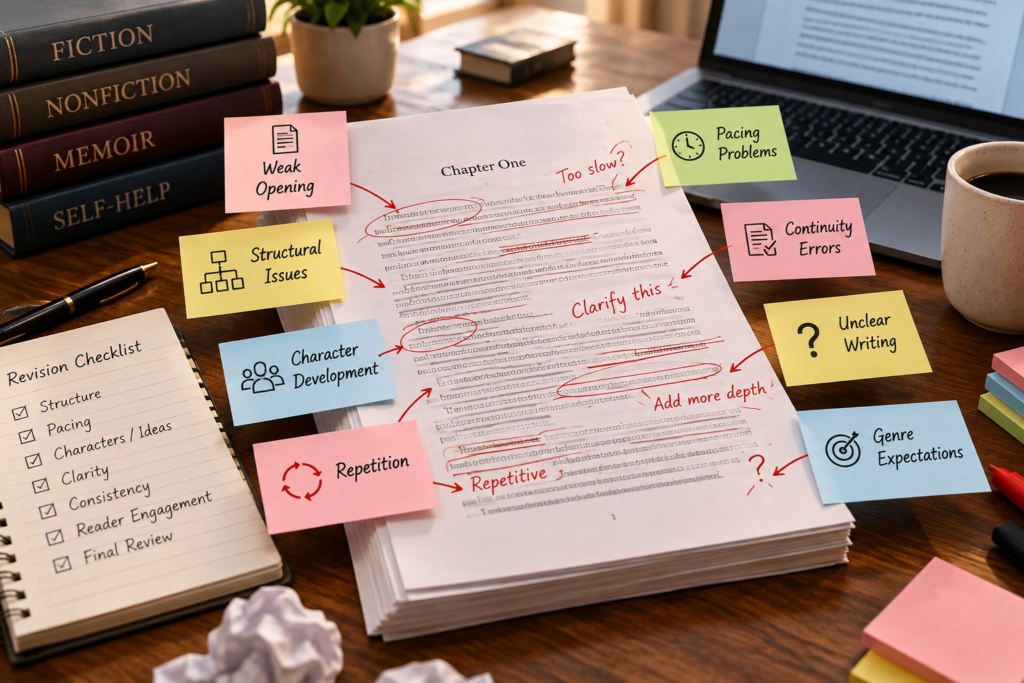
1. Your Opening Pages Fail to Capture the Reader’s Interest
Your opening pages establish the reader’s first impression of your book.
They introduce the writing style, set expectations, and give readers a reason to continue.
One of the most common signs your book needs editing is an opening that spends too much time explaining background information before introducing something meaningful.
In fiction, this might involve several pages of character history or descriptions before the story develops any momentum.
In nonfiction, it could mean lengthy introductions that delay the practical information or insight readers are expecting.
Not every book needs a dramatic opening. Literary fiction, memoir, and reflective nonfiction often benefit from quieter beginnings.
What matters is whether the opening creates curiosity, establishes an engaging voice, or introduces a compelling question.
How to check your manuscript: Read your first five pages without considering what happens later. Would an unfamiliar reader understand why the book is worth continuing?
If the opening relies heavily on information that only becomes meaningful much later, consider strengthening its immediate impact.
2. Your Manuscript Has Structural Problems
A strong book needs a structure that supports its central purpose.
In fiction, events should develop in a way that feels intentional, whether the narrative follows a traditional sequence or experiments with chronology.
Characters’ decisions should influence subsequent developments, and important scenes should contribute to the larger story.
For nonfiction, chapters should build upon one another, helping readers understand the subject or progress toward a clear outcome.
Structural weaknesses often appear as disconnected chapters, unnecessary subplots, repetitive explanations, or sections that interrupt the book’s momentum.
These problems are among the primary reasons authors seek developmental editing.
How to check your manuscript: Write a one-sentence explanation of what each chapter contributes to the book.
If several chapters don’t advance the story, develop an important idea, deepen characterization, or serve another meaningful purpose, they may need restructuring.
3. Your Characters or Main Ideas Need More Development
An interesting premise is only the beginning of a successful book.
Fiction readers need characters whose motivations, decisions, and emotional responses make sense within the story.
A character who suddenly changes their beliefs or makes a life-altering decision without sufficient development may feel unconvincing.
Nonfiction writers encounter a similar problem when introducing important ideas without adequate explanation, evidence, or practical examples.
Readers shouldn’t have to rely on the author’s unstated knowledge to understand a central argument.
How to check your manuscript: Identify the five most important developments in your book.
For fiction, ask whether the characters’ actions and emotional responses are adequately established.
For nonfiction, ask whether your main arguments are supported by clear explanations, credible evidence, or relevant examples.
If important developments feel unearned or incomplete, your manuscript may need more work before publishing.
4. The Pacing Is Too Slow or Too Rushed
Pacing determines how readers experience a book’s progression.
A suspense novel may rely on rapid developments and escalating tension, while a memoir might need space for reflection and emotional understanding.
Neither approach is inherently better. Problems arise when the pacing no longer supports the material.
A novel may spend several chapters preparing for an important event, only to resolve it in a few paragraphs.
A nonfiction book may devote excessive space to introductory explanations while rushing through the information readers actually need.
During a manuscript assessment, editors examine whether the pacing suits the book’s genre, intended audience, and narrative purpose.
How to check your manuscript: Mark passages where the writing feels repetitive, unusually slow, or unnecessarily rushed.
Then determine whether those sections need additional development, tighter writing, or a different position within the manuscript.
Effective pacing isn’t about making every chapter fast. It’s about ensuring every section receives the appropriate amount of attention.
5. Your Manuscript Repeats the Same Information
Repetition is easy to overlook when you’ve been revising individual chapters over a long period.
You might explain a character’s background in several places, repeat the same argument across multiple chapters, or revisit information readers already understand.
Some repetition is intentional and valuable. Recurring themes, meaningful phrases, and narrative patterns can strengthen a book.
Unnecessary repetition, however, can slow the reading experience and make a manuscript feel less polished.
How to check your manuscript: Look for explanations, descriptions, or ideas that appear multiple times.
Ask whether each repetition introduces new information, develops an existing theme, or serves a specific purpose.
If removing a passage would not affect the reader’s understanding or experience, it may be worth tightening.
Professional manuscript editing can help identify redundant material while preserving the author’s voice and intended emphasis.
6. Your Book Contains Continuity and Consistency Errors
Consistency problems can damage a reader’s confidence in a book.
In fiction, these might include changing character ages, contradictory timelines, unexplained location changes, or events that don’t align with earlier chapters.
Fantasy and science fiction manuscripts also need consistency in their worldbuilding, rules, mythology, and fictional systems.
For nonfiction, accuracy is equally important.
Conflicting dates, unsupported statistics, inconsistent terminology, or unclear references can weaken the credibility of the material.
Even small errors can become distracting when they accumulate.
How to check your manuscript: Create a reference document recording important names, dates, timelines, locations, character relationships, terminology, and major events.
Review these details separately from grammar and sentence-level editing.
For nonfiction, verify factual claims against appropriate sources rather than relying on memory alone.
7. Readers Struggle to Understand Your Writing
Authors are deeply familiar with their manuscripts.
You know why characters behave a certain way, how events connect, and what your arguments are intended to demonstrate.
Readers only know what appears on the page.
This difference can create gaps between what you intend to communicate and what readers actually understand.
Unclear transitions, unexplained references, complicated sentences, excessive jargon, and inconsistent viewpoints can make a manuscript difficult to follow.
Of course, complexity isn’t inherently a problem. Some books intentionally challenge readers or leave certain questions unanswered.
The issue is whether confusion serves a creative purpose or results from missing information.
How to check your manuscript: Ask someone unfamiliar with your book to read a sample.
Rather than asking only whether they liked it, ask which passages were confusing, what they had difficulty following, and where they needed more context.
If multiple readers identify similar problems, those sections deserve attention during revision.
8. Your Manuscript Doesn’t Meet Reader or Genre Expectations
Every genre comes with certain reader expectations.
A mystery typically promises an engaging question and a meaningful process of discovery.
A genre romance generally develops a central romantic relationship and delivers an emotionally satisfying, optimistic ending.
A practical business book may promise strategies readers can apply to their professional lives.
Understanding these expectations is an important part of learning how to prepare a manuscript for publishing.
Originality matters, and authors should not feel obligated to imitate established formulas.
However, departing from genre conventions should be a deliberate creative decision.
If readers expect one kind of experience and receive something entirely different, the book may struggle to connect with its intended audience.
How to check your manuscript: Identify several books published in your genre that appeal to readers similar to yours.
Consider how they establish expectations, organize their material, and deliver on the promises made through their titles, descriptions, and opening chapters.
Then evaluate whether your manuscript delivers the experience it promises.
9. You Haven’t Received Independent Feedback
One of the biggest obstacles to manuscript readiness is relying entirely on your own judgment.
After spending months or years with a manuscript, it becomes difficult to recognize problems that may be immediately apparent to a new reader.
Friends and family can offer encouragement and valuable reactions, but they may hesitate to provide critical feedback.
Beta readers, writing groups, critique partners, and professional editors can offer different perspectives.
A professional manuscript assessment is particularly useful when you know something isn’t working but cannot identify the underlying problem.
An editor may recognize that an issue you perceive as slow pacing actually originates from weak characterization, unnecessary scenes, or an unclear narrative direction.
How to check your manuscript: Have at least a few suitable readers evaluated your book independently?
Have you received specific feedback about structure, clarity, pacing, and the overall reading experience?
If not, outside feedback may be a valuable next step before publication.
10. You’re Polishing Sentences Before Fixing Bigger Problems
Correcting grammar, improving word choice, and refining sentences can make a manuscript feel more professional.
However, these improvements won’t solve major structural problems.
An author might spend weeks polishing a chapter that eventually needs to be removed or rewritten.
This is why the professional book editing process usually addresses larger editorial concerns before moving to detailed copyediting and proofreading.
Developmental editing focuses on the book’s foundation, while later editorial stages refine the writing and correct technical errors.
How to check your manuscript: Before concentrating on punctuation and sentence-level improvements, ask whether you’re confident in the book’s structure, progression, and central purpose.
If you’re still uncertain about important chapters, character arcs, or major arguments, resolve those issues before investing heavily in final polishing.
Finished Draft vs. Publication-Ready Manuscript
Understanding the difference between a completed draft and a publication-ready manuscript can help authors set realistic expectations.
| Finished Draft | Publication-Ready Manuscript |
|---|---|
| Contains the complete story or central ideas | Delivers a coherent reading experience |
| May contain structural gaps | Has undergone appropriate structural review |
| Reflects the author’s initial intentions | Communicates those intentions effectively |
| May include repetition or inconsistencies | Has been revised for clarity and consistency |
| Has primarily been reviewed by the author | Has benefited from relevant outside feedback |
| Needs further editorial evaluation | Prepared for appropriate publishing stage |
A finished draft is an achievement, but it isn’t necessarily the final version readers should encounter.
The revision process helps transform raw material into a stronger, more cohesive book.
What Type of Editing Does Your Manuscript Need?
Recognizing that your manuscript needs improvement is only the beginning.
Different types of editing address different problems, and choosing the appropriate service can help authors avoid unnecessary work.
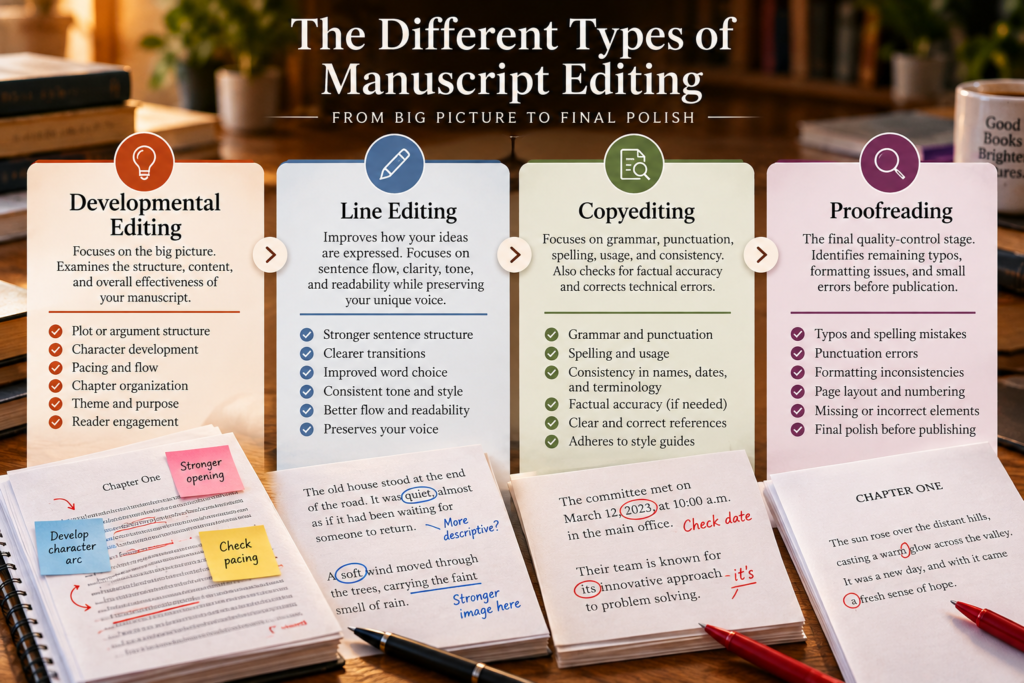
Developmental Editing
Developmental editing examines the overall structure and effectiveness of a manuscript.
For fiction, it focuses on elements such as plot, characterization, pacing, narrative structure, and thematic development.
For nonfiction, it may examine organization, arguments, explanations, and the manuscript’s ability to meet reader expectations.
This is often the most appropriate starting point when a manuscript has significant structural or developmental concerns.
Line Editing
Line editing improves how ideas are expressed.
It examines sentence flow, transitions, word choice, tone, rhythm, and readability.
The purpose is to strengthen the writing without unnecessarily changing the author’s distinctive voice.
Copyediting
Copyediting focuses on grammar, punctuation, spelling, usage, and consistency.
Depending on the agreed scope, it may also identify factual discrepancies, inconsistent terminology, and unclear references.
Proofreading
Proofreading is generally the final quality-control stage after editing and layout.
It identifies remaining typographical errors, punctuation issues, formatting mistakes, and production inconsistencies.
Proofreading is important, but it cannot replace developmental editing when a manuscript still has fundamental structural problems.
For more information about manuscript preparation and editorial services, visit the Publishers of New York Author Resources.
Is My Manuscript Ready for Publishing? A Practical Checklist
Before submitting your book, conduct a structured review of its editorial readiness.
Use this checklist to identify areas that may require further attention.
- My opening gives readers a compelling reason to continue.
- The book has a clear central purpose, story, or argument.
- Every chapter contributes meaningfully to the manuscript.
- Important characters or ideas are sufficiently developed.
- The pacing supports the genre and intended reading experience.
- Unnecessary repetition and inconsistencies have been addressed.
- Readers can understand the material without additional explanations.
- The manuscript meets its intended audience’s expectations.
- I have received constructive outside feedback.
- Major editorial concerns have been addressed before final proofreading.
This checklist isn’t a guarantee of publication readiness, but it provides a useful starting point.
If several areas remain uncertain, another revision or a professional manuscript assessment may help clarify what your book needs.
Read Your Manuscript With Fresh Eyes
After completing a major draft, allow yourself some distance before reviewing it again.
Reading after a break can make it easier to identify awkward transitions, unnecessary explanations, and sections that need further development.
Review the Book in a Different Format
Print the manuscript, read it on another device, or listen to it using text-to-speech software.
A different format may reveal repetitive language, unnatural dialogue, or sentences that are difficult to follow.
Address Major Problems First
Avoid correcting every sentence during your initial assessment.
Focus first on structure, clarity, development, and pacing.
Once the larger issues are resolved, move toward increasingly detailed editing.
This approach generally makes the revision process more efficient.
When Should You Get a Professional Manuscript Assessment?
Not every author needs professional editorial feedback at the same stage.
Some seek guidance after finishing their first draft, while others complete several rounds of revision independently.
However, a manuscript assessment can be particularly useful when:
- You have completed your book but aren’t sure whether it’s ready for publishing.
- You’ve received conflicting feedback from readers.
- You recognize weaknesses but cannot determine how to fix them.
- Your manuscript has complex structural or developmental challenges.
- You want an informed editorial perspective before making publishing decisions.
A professional assessment can identify the manuscript’s strengths, explain its weaknesses, and recommend an appropriate path forward.
At Publishers of New York, manuscript consideration forms part of a broader publishing process focused on understanding each book’s voice, editorial needs, and potential readership.
You can explore the publisher’s approach in its Publishing Process Guide.
For a broader overview of the journey from manuscript preparation to publication, see How to Publish a Book in 2026.
Frequently Asked Questions About Manuscript Readiness
How do I know if my manuscript is ready for publishing?
Your manuscript may be ready for the next publishing stage when its structure is coherent, its central idea is well developed, its writing is clear, and significant editorial issues have been addressed.
Independent feedback can help you identify remaining weaknesses before submission.
Should I edit my manuscript before sending it to a publisher?
Yes, you should generally revise and review your manuscript before submission.
However, professional editing requirements vary by publisher and publishing model. Always check the publisher’s manuscript submission guidelines before paying for editorial services.
Can I publish my book without hiring an editor?
Yes. Independent authors can choose to publish without professional editing.
However, an experienced editor can identify structural, stylistic, and technical problems that authors may overlook.
The level of editorial support needed depends on the manuscript’s condition and publishing goals.
What is the difference between a manuscript assessment and developmental editing?
A manuscript assessment evaluates a book’s strengths, weaknesses, and areas requiring improvement, often through an editorial report.
Developmental editing generally involves a more extensive review of structure, content, pacing, characterization, or argument development, with detailed editorial guidance.
How many times should I revise my manuscript before publishing?
There is no fixed number.
Some manuscripts require only a few revision rounds, while others need extensive development.
The goal is to resolve meaningful problems and strengthen the reading experience rather than reach a particular revision count.
Is My Manuscript Ready for Publishing? What to Do Next
Finishing a book is a significant milestone, but publication should not be treated as a race.
The work completed before a manuscript reaches readers can influence how effectively it communicates its ideas, connects with its audience, and fulfills the author’s creative intentions.
Sometimes the next step is another revision. Sometimes it’s targeted editorial assistance. And sometimes a manuscript is ready for professional publishing consideration.
Understanding the difference helps authors make informed decisions and approach publication with greater confidence.
If you’re still asking yourself, Is my manuscript ready for publishing? consider whether your book delivers the experience you intended and whether an unfamiliar reader would understand and appreciate that experience.
At Publishers of New York, we believe thoughtful publishing begins with understanding the manuscript.
Our editorial approach considers the strengths, distinctive voice, and development needs of each book.
If you’ve completed your manuscript and are ready to explore the next stage of your publishing journey, we invite you to submit your manuscript for editorial consideration.
A finished manuscript is an accomplishment. A carefully developed book is the opportunity to make that accomplishment count.